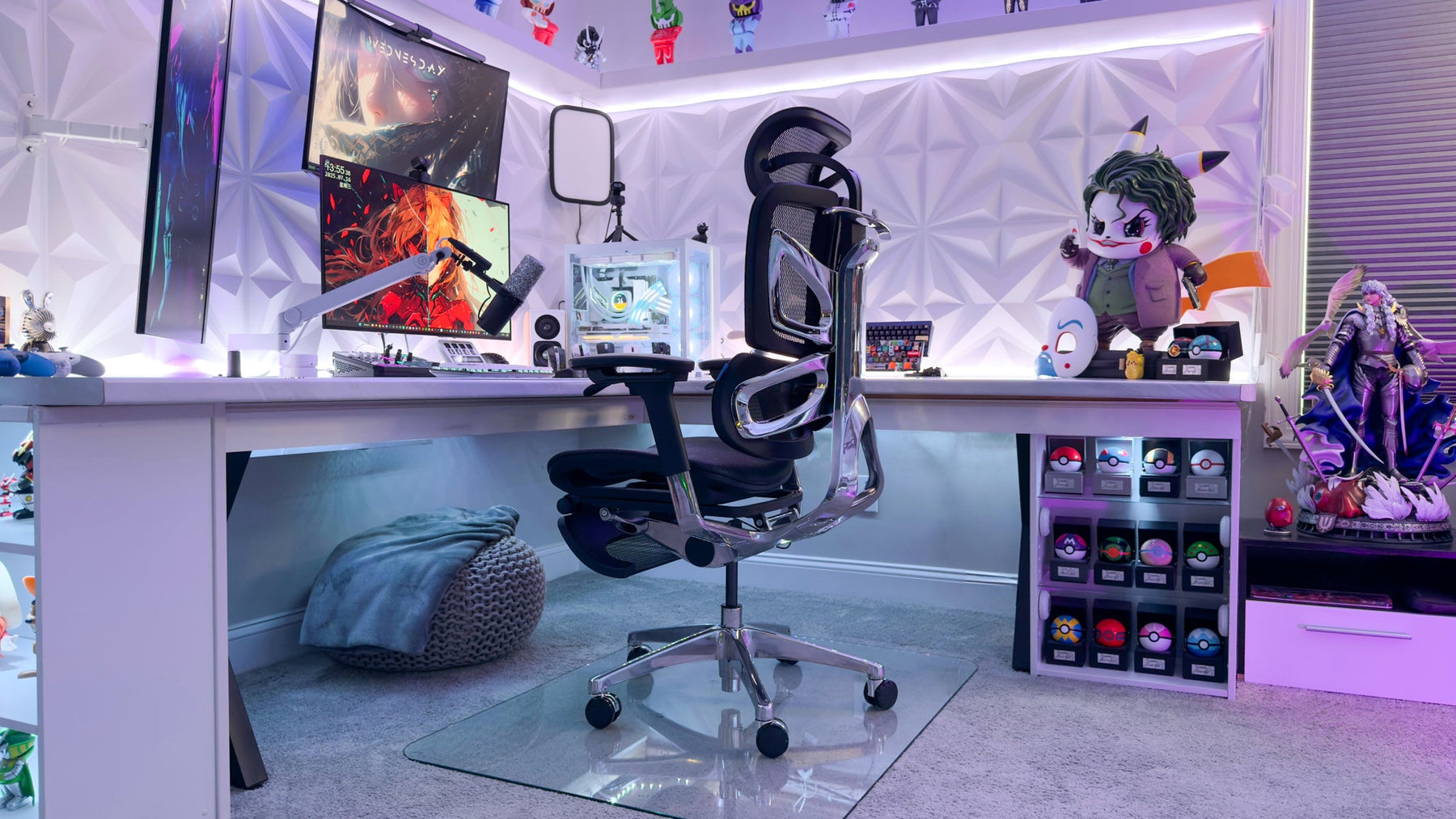
Protect carpet and improve chair movement by matching a carpet-rated mat or rigid platform to the floor system, chair load, and complete caster path.
The right ergonomic setup should adapt to your body, support frequent movement, and stay comfortable through a full workday.
Put a chair mat or rigid chair platform specifically rated for carpet under a rolling office chair when you want to protect the carpet and create a more predictable rolling surface. Match it to the installed carpet, the cushion underneath, the chair and user load, and the area your casters actually travel. Do not choose from color or thickness alone.
Rolling directly on carpet is not automatically unsafe, but it is a different decision. Repeated caster traffic concentrates wear in a small area, while soft carpet can increase rolling effort or let an underspecified mat flex. The right solution therefore depends on two separate goals: preserving the carpet and making the chair move as intended.
Start with the problem you need to solve
Before shopping, decide which failure you are trying to prevent. People often buy a mat to solve one problem and judge it by another.
- Carpet appearance: repeated back-and-forth movement can disturb or wear the fibers in the chair's travel zone.
- Rolling effort: casters can sink farther into a soft carpet-and-cushion system, making small position changes harder.
- Chair stability: every caster needs continuous support through normal work, reaching, and standing up.
- Rental or warranty concerns: the carpet owner, installer, or manufacturer may specify acceptable protection and cleaning methods.
Bentley Mills' carpet maintenance guidance recommends chair pads because repeated back-and-forth movement can distort carpet fibers. It also notes that carpet-type casters may reduce the effect on some low, dense loop and cut-loop carpets, while greater maintenance and appearance change should be expected without pads. Meanwhile, OSHA's workstation evaluation checklist says chair casters should be appropriate for the floor surface. Taken together, those points support a system decision—not the assumption that any mat or any wheel will work on every carpet.
Identify the floor before choosing what goes under the chair
"Carpet" is not one surface. A dense, low-profile carpet over a firm cushion behaves differently from a thick, plush construction over a soft pad. The same chair mat may remain stable on one and form caster wells, bow, or move on the other.
Record the installed carpet and cushion
Check the carpet invoice, product label, property records, or installer information. Record the carpet construction and any pile-height or cushion details the supplier provides. If you cannot identify them, ask the carpet manufacturer, installer, landlord, or flooring retailer rather than estimating from a photo.
Also note whether the floor is broadloom carpet, carpet tile, or an area rug placed over another surface. These are not interchangeable applications. A product described merely as "for carpet" may still have limits related to pile, cushion, total load, dimensions, or indoor floor type.
Check the chair and caster condition

A protection layer cannot compensate for a damaged chair base, a loose caster, or a wheel that does not rotate freely. With the chair unloaded, inspect all five casters for wrapped hair, debris, flat spots, cracks, wobble, or a stem that is not fully seated. Follow the chair maker's maintenance instructions; stop using the chair if the base or caster attachment is damaged.
Do not assume that soft roller-style casters marketed for hard floors are the best answer for carpet. Caster design, stem fit, wheel diameter, load rating, and floor compatibility all matter. Use only a caster the chair manufacturer approves for the chair and the intended floor.
Compare the practical options
The best answer is usually a carpet-rated chair mat or a carpet-rated rigid platform, but direct rolling may remain an option when both the flooring and chair guidance allow it. Use this comparison to narrow the choice.
| What goes under the chair | When it can make sense | What must be verified | Reject it when |
|---|---|---|---|
| Carpet-rated chair mat | You want a defined rolling surface and protection from concentrated caster traffic | Approved carpet and cushion range, total supported load, dimensions, underside design, edge profile, and care instructions | It flexes deeply, walks, curls, cracks, or lets a caster drop off during normal movement |
| Carpet-rated rigid chair platform | A firm surface is needed over a softer floor system and the product is designed for that application | Floor compatibility, structural/load rating, edge treatment, full support, and installation requirements | It rocks, bridges an uneven area, has an unsupported joint, or creates an uncontrolled trip edge |
| Directly on carpet with approved casters | The carpet owner permits rolling-chair use and the chair maker approves the caster-floor combination | Rolling effort, chair control, visible wear, caster condition, and required maintenance | The chair becomes hard to reposition, fibers distort, casters snag, or wear concentrates in the task zone |
| Area rug | It is part of the room design and is explicitly suitable for both the underlying floor and rolling-chair use | Rug stability, pile, backing, edge behavior, cleaning, and the flooring supplier's guidance | It bunches, shifts, catches a caster, adds too much compression, or traps soil against the carpet |
Avoid improvised loose boards, thin household plastic, interlocking tiles, or a hard-floor mat that is not rated for carpet. A surface can look flat when the chair is empty and still deflect or separate under the concentrated load at five caster contact points.
Map the complete rolling zone before selecting a size
A chair mat fails its job when it covers the static chair footprint but not the way the chair moves. Catalog dimensions cannot reveal your desk reach, preferred exit side, or how far you roll back to stand. Trace the real caster path first.
- Set the workstation in its final position. Place the desk, chair, footrest, drawers, and other items where they will be used.
- Sit and complete normal movements. Move from the keyboard to side storage, reach the controls you use, roll back to stand, and approach the desk again.
- Mark the outer caster path. Use removable painter's tape or small paper markers outside the farthest position reached by any caster. Do not attach tape to carpet unless the flooring provider allows it.
- Outline the full zone. Connect the outer marks. Include the side you use to enter and exit, not just the rectangle beneath the desk.
- Keep all five casters supported. Select a surface that contains the entire path with a practical margin so one caster does not repeatedly drop over an edge.
- Move transition edges away from push-off points. Avoid placing an edge where a foot normally braces, where a doorway narrows, or where someone repeatedly walks.
A mat with a front lip can extend into the knee space under some desks, but the shape is useful only when it matches your traced zone. An attractive outline that leaves the usual exit path uncovered is the wrong size.
Do not use one universal thickness rule
Search results often reduce selection to a single thickness assigned to "low," "medium," or "high" pile. That shortcut can fail because the support system includes the carpet, cushion, mat material, mat construction, chair weight, user weight, and how the casters concentrate the load.
Use the chair-mat or platform manufacturer's application table and load limits. Match its definitions to the documented flooring—not to your own guess about whether the carpet feels thick. If the manufacturer does not state compatibility with your carpet-and-cushion system, ask before buying or choose a product with clearer documentation.
Look for failure signals during the return period:
- deep caster impressions that do not recover as the chair moves;
- visible bowing, rippling, or a surface that pumps up and down;
- cracks, whitening, split seams, or edges beginning to curl;
- a mat that walks across the carpet or exposes the original rolling path;
- one or more casters repeatedly leaving the protected surface;
- a sharp edge or height change in a normal walking or push-off path.
Stop using a cracked, unstable, or badly curled surface. Do not solve movement by driving unapproved fasteners through the mat and carpet; follow the flooring and mat manufacturers' installation instructions.
Why an area rug is not the default carpet protector
An area rug can make a workspace look finished, but it adds another textile layer rather than creating a consistently firm rolling surface. Its pile, backing, edge, and movement may change how the casters roll, and the added layer can compress or shift over the installed carpet.
If you want a rug in the chair zone, verify three things in writing: the carpet manufacturer allows that rug and backing, the rug maker allows rolling-chair traffic, and the chair remains stable through the full movement test. The Shaw carpet care guidance notes that rolling chairs should use a chair pad designed for carpet and that rugs placed over carpet need periodic removal and cleaning. That is a useful reminder that a decorative rug is not automatically a wear-control system.
Reject the rug option if an edge catches a caster, the rug bunches, the chair needs excessive force to move, or you cannot inspect and clean beneath it. A properly rated mat or platform is the clearer choice when protection and predictable rolling are the main goals.
Install the surface, then run a seated verification
Follow the product's unpacking and flattening instructions. Some materials need time to reach room temperature or lie flat; forcing a curled edge in the opposite direction can damage it. Make sure the carpet is clean and dry first, and check that no grit or hard object is trapped underneath.
- Place the mat or platform over the traced rolling zone in the orientation specified by its manufacturer.
- Check that it lies flat, is fully supported, and does not block a door, floor vent, cable route, or desk mechanism.
- Set the chair at the center while unloaded and confirm that every caster rolls and swivels normally.
- Sit in the chair and repeat the actual work, reach, exit, and return movements.
- Confirm that all five casters remain on the surface and no edge lifts, moves, or catches a shoe.
- Inspect again after several days of normal use for movement, impressions, fiber change, cracks, or curled edges.
The seated test matters because the empty chair does not reproduce the working load. If the surface behaves differently once occupied, treat the occupied result as the decision point.
Maintain the floor, mat, and casters as one system
Vacuum exposed carpet and the chair's rolling zone according to the flooring maker's instructions. Periodically remove the mat only when it can be lifted safely and the manufacturer permits it; clean and dry both surfaces as directed before replacing it. Soil left under a moving or flexing layer can become abrasive.
Inspect caster treads for hair and debris, and watch whether each wheel swivels before it rolls. A wheel that drags instead of rolling can change the load on the mat and carpet. If a caster is damaged or no longer secure, use the chair maker's approved part and procedure. The adjacent office-chair wheel replacement guide explains the replacement task; it does not replace the model-specific instructions for your chair.
What OdinLake owners can verify
OdinLake currently lists replacement casters for O1, O2, and O3 chairs. The listing identifies supported chair models, but it does not state that the casters are suitable for every carpet type. Confirm the exact chair model, current part specification, floor application, and installation instructions before treating a replacement as a carpet solution.
If the documentation does not answer the floor-compatibility question, send the chair model and the carpet-and-cushion details to OdinLake support. That produces a more useful answer than choosing a wheel by appearance or diameter alone.
Frequently Asked Questions
Can you use an office chair directly on carpet?
Yes, when the carpet owner permits rolling-chair use and the chair manufacturer approves the casters for that floor. Test rolling effort and control while seated, then inspect for concentrated wear. A carpet-rated chair mat or rigid platform remains the clearer protection choice when preserving the carpet is a priority.
Do I need a chair mat on low-pile carpet?
Low pile does not remove the risk of repeated caster traffic. Use the carpet manufacturer's maintenance guidance, any rental requirements, and the chair-mat maker's application limits. If appearance protection matters, a mat specifically rated for the documented low-pile carpet and cushion is generally more defensible than relying on pile height alone.
What type of chair mat is best for thick carpet?
Choose a mat or rigid platform whose manufacturer explicitly approves your carpet construction, cushion, total load, and rolling-chair application. Do not rely on a universal thickness chart. If the floor details are unknown or the product supplies no compatibility table, ask the flooring and mat manufacturers before buying.
How big should a chair mat be?
It should cover the complete path of all five casters during typing, reaching, rolling back, standing, and entering or leaving the desk. Trace that zone in the finished room, then add a practical margin. Keep mat edges away from normal push-off points, doorways, and walking routes where possible.
Will an area rug protect carpet from office-chair wheels?
Not reliably by default. A rug adds pile, backing, edges, and possible movement, and it may change rolling effort without controlling concentrated wear. Use one only if the carpet and rug manufacturers allow the combination and the rug is suitable for rolling-chair traffic; otherwise choose a carpet-rated mat or platform.
Can a chair mat damage carpet?
An incompatible, dirty, moving, or failing mat can create problems. Match it to the carpet and cushion, clean both surfaces as directed, and inspect for flexing, movement, trapped grit, discoloration, or fiber change. Stop using it if it cracks, curls, walks, or produces visible damage, and consult the flooring supplier.