The right ergonomic setup should adapt to your body, support frequent movement, and stay comfortable through a full workday.
A saddle chair with a backrest works best for people who sit close to their work, turn or reach often, and want somewhere to lean during pauses. That includes artists, crafters, beauty professionals, technicians, and home users whose tasks involve more movement than conventional computer work.
Adding a backrest does not turn a saddle chair into a full-size office chair. It simply adds a compact point of support while preserving the smaller footprint and freedom of movement that make saddle seating useful.
What Does the Backrest Add to a Saddle Chair?
A backless saddle stool leaves the upper body unsupported, which can be useful when you constantly turn, reach, or move between nearby stations. Some users, however, want a place to lean while reviewing their work or taking a short break from a forward working position.
That is where a compact backrest helps. Depending on its shape and height, it can support the lower or middle back without surrounding the body like a tall office-chair back.
The backrest is most useful as an additional position, not as a reason to sit still for hours. It should meet your back in a comfortable place without pushing you too far from the work surface.
Who Is a Saddle Chair With a Backrest Best For?
Artists, Crafters, and Makers
Drawing, jewelry making, model building, sewing, and other detailed projects often require you to move closer to the work surface. Deep seats, wide armrests, and large backrests can get in the way.
A compact saddle chair leaves more room around the arms and legs, making it easier to turn toward tools or materials. When you stop to review a drawing, check instructions, or prepare the next stage of a project, the backrest gives you somewhere to lean.
This setup makes the most sense when your work alternates between focused, forward activity and brief pauses. For several uninterrupted hours at a computer, a more adjustable office chair may be a better primary seat.
Beauty, Studio, and Hands-On Professionals
Hairstylists, estheticians, tattoo artists, photographers, and other hands-on professionals often work around a client, tool cart, or adjustable table. They need to get close, rotate frequently, and reposition without dragging a large chair through the space.
A saddle chair with a backrest can support that routine while providing a place to lean between tasks. Working height and floor conditions still matter. If the job involves precise foot control or requires the chair to stay completely still, test whether the casters remain secure during use.
For client-facing services, the upholstery and seams must also be suitable for the cleaning and hygiene procedures used in that setting.
Dental and clinical professionals often use purpose-built saddle stools, but those environments may require specific height ranges, foot support, upholstery, cleaning procedures, or other workplace features. A general-purpose home chair does not meet professional clinical requirements simply because it has a saddle-shaped seat.
People Working in Small or Shared Spaces
A traditional ergonomic chair can take up considerable room once wide armrests, a headrest, and a large reclining back are included. A compact saddle chair is easier to place in a bedroom workspace, creative corner, treatment room, or multipurpose studio.
Its smaller profile also helps when the chair needs to move between tasks or tuck closer to a table after use. Check the complete base width and depth rather than judging the chair by its seat alone. Our guide to measuring an office chair explains how different dimensions affect body fit, desk clearance, and floor space.
Users Who Want More Support Than a Backless Stool
Some people like the mobility of a stool but do not want to remain unsupported through every task. A backrest adds another sitting position without requiring a large conventional chair.
It can be especially useful when moving from a backless stool or alternating between active work and lighter activities such as reading, reviewing notes, or using a tablet.
The fit still needs to be checked. Backrest height, curvature, and distance from the seat determine where the support makes contact. If it presses in the wrong place or can only be reached by leaning too far back, it will have limited value during actual work.
Who May Prefer a Different Type of Chair?
A saddle chair with a backrest is not the right choice for every routine.
People who spend most of the day typing, attending meetings, or working continuously at one desk may need an office chair with adjustable seat depth, armrests, lumbar support, and recline. Those controls make it easier to fit the chair to a fixed computer workstation and move between a wider range of supported positions. OdinLake's ergonomic chair collection includes options designed for that type of work.
Fit can also rule out a saddle chair. Its seat-height range must work with both the user and the work surface. Because a saddle seat positions the body differently from a flat office-chair seat, measurements from an existing chair may not transfer directly.
A compact backrest may also feel insufficient if you need upper-back or head support, prefer a deep recline, or rely on fixed arm support. Persistent pain, balance limitations, or other conditions that affect sitting tolerance require individualized guidance rather than a chair category presented as a treatment.
How to Tell Whether the Chair Fits Your Work
Check the Working Height
You should be able to approach the task without raising your shoulders or bending excessively through the neck and upper body. Your hands should reach the work area comfortably, with your feet supported by the floor or a suitable footrest.
Compare the chair's full seat-height range with the table, counter, or equipment you actually use. A recommended user-height range is only a starting point because leg proportions and work-surface height also affect fit.
Check the Backrest Contact
Begin in your normal working position, then move back toward the backrest. It should be easy to reach during a pause without forcing you to roll away from the task or reorganize your entire setup.
Test each available position if the backrest is adjustable. With a fixed backrest, make sure its height and shape suit your body before committing to longer sessions.
Check Movement and Stability
Swivel and casters help when you move between nearby tools, but more mobility is not always better. On your actual flooring, check whether the chair remains easy to control during tasks involving pedals, resistance, or precise hand movements.
Getting on and off the chair should also feel manageable. The saddle contour, seat width, clothing, and clearance around the base all affect daily use.
Check the Length of Each Session
Consider how long you normally remain seated before standing or changing tasks. A compact saddle chair is well suited to active sessions with regular movement. During long stretches of uninterrupted desk work, greater adjustability and broader back support may matter more than a small footprint.
Even a comfortable chair should not keep you in one position indefinitely. Regular movement and task changes remain important.
Is the OdinLake C1 Arc a Good Fit?
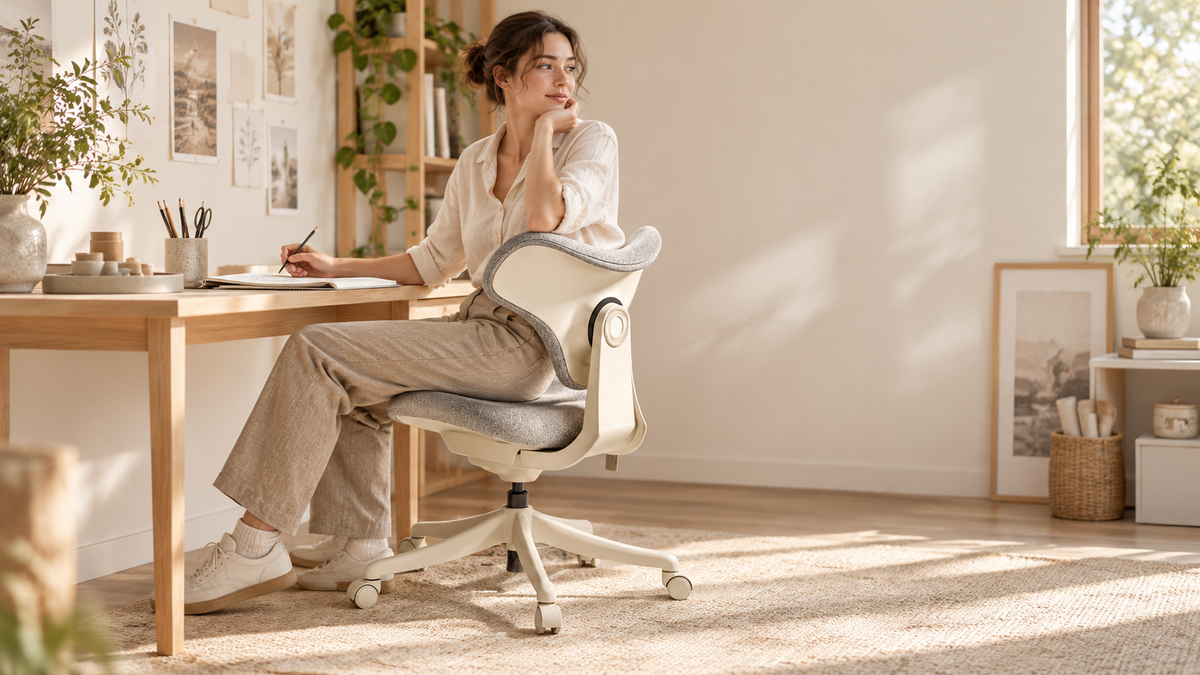
The OdinLake C1 Arc is designed for flexible sitting without the size or visual weight of a traditional office chair. It combines a saddle-inspired upholstered seat, compact curved backrest, height adjustment, full swivel, and smooth-rolling casters.
Its compact proportions fit naturally into creative corners, bedroom workspaces, studios, and other areas where a full-size ergonomic chair may feel excessive. The open design makes turning and repositioning easy, while the backrest provides a place to lean during quieter moments.
C1 Arc is best suited to light work, creative activities, and mixed everyday use. For long, uninterrupted computer sessions or extensive lumbar, armrest, seat-depth, and recline adjustment, choose a full-size ergonomic chair instead.
Before choosing C1 Arc, compare its dimensions and adjustment range with your body, table, and available floor space. If the task involves a foot pedal or requires a fixed position, check how the casters behave on your flooring.
Final Thoughts
A saddle chair with a backrest is a practical choice when your work combines close access, frequent movement, and occasional supported pauses. It can suit creative work, hands-on services, compact rooms, and anyone who wants more support than a backless stool provides.
It is not a universal replacement for a fully adjustable office chair. The right choice depends on the work-surface height, session length, required movement, and the kind of support you expect.
Choose based on how the chair fits the real task—not simply because the saddle seat or backrest is described as ergonomic.
Frequently Asked Questions
Is a backrest necessary on a saddle chair?
Not always. A backless saddle stool provides maximum freedom of movement. Choose a backrest if you want somewhere to lean during pauses or regularly switch between active and lighter seated tasks.
Can you use a saddle chair with a backrest all day?
It depends on the chair, the user, and the task. A compact saddle chair usually works better for active work with regular position changes. Long, uninterrupted computer work may call for a fully adjustable ergonomic chair.
Does a backrest automatically make a saddle chair ergonomic?
No. The chair must still fit your body, work-surface height, movement needs, and typical session length. A poorly positioned backrest can be difficult to use even when the seat fits.
Should the backrest touch your back while you work?
Not during every task. When you move upright or lean back for a pause, the support should be easy to reach without forcing you too far from the work surface.
What should you check before buying a saddle chair with a backrest?
Check the seat-height range, saddle shape, backrest position, complete base dimensions, caster behavior, and clearance around the work surface. When possible, test the chair while performing the task for which you plan to use it.