The right ergonomic setup should adapt to your body, support frequent movement, and stay comfortable through a full workday.
One person works from home on Tuesdays and Thursdays. The other uses the same desk on the days in between. There’s room for one chair, so every handoff comes with a familiar question: who moved the seat again?
In a 2025 Federal Reserve survey, 39% of U.S. workers reported working from home at least some of the time in the previous week. The Washington Post has also documented how couples divide up space at home when both need a place to work. In one r/OfficeChairs discussion, a 6′1″ user described sharing a desk with a 5′4″ partner. Chairs that fit him tended to be too deep for her, while smaller chairs felt cramped to him. They had room for only one. Federal Reserve survey · The Washington Post · Reddit discussion
Why a shared office chair can fit one person and frustrate the other
Start with what each person does once they sit down. If one person slides forward to get their feet flat, check whether the seat is too high or too deep for them. If the other feels like most of their thighs extend past the seat, check how much usable depth the chair offers when extended. Both people might be within the manufacturer’s suggested height range and still need different settings. Height is a starting point. Leg length, torso length, and desk height tell you more about how the chair will feel in use. OSHA chair guidance · OdinLake fit guide
Measure both people at the desk they’ll actually share
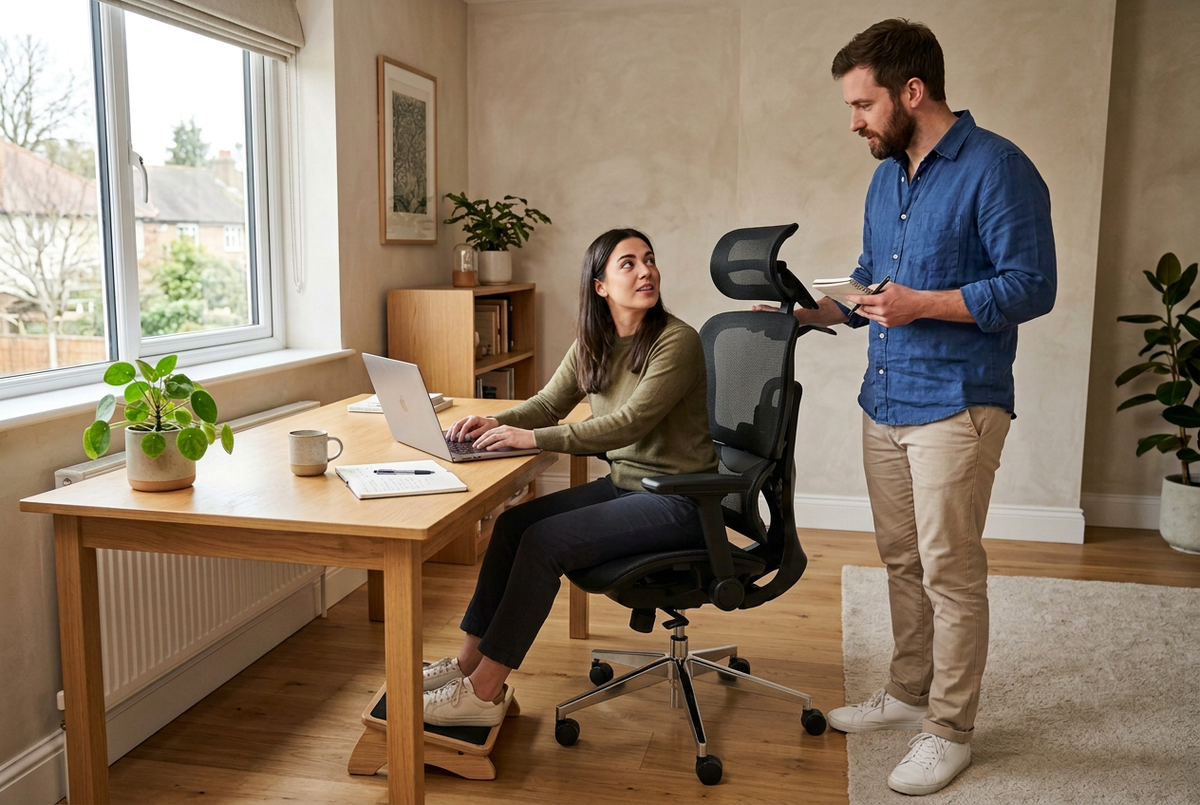
Have each person sit at the desk with their usual shoes and type a few lines. Find a seat height where they can keep their feet supported and reach the keyboard without lifting their shoulders. If a fixed-height desk makes one person raise the chair, try a stable footrest. Then check that their knees still have room and the chair can pull in far enough to work. Record the height and whether the footrest was needed. OSHA chair guidance
Next, check seat depth. Sit back against the backrest and see where the front edge lands. If it presses into the backs of the knees, try a shorter setting. If the seat feels too short under the thighs, extend it and check again. If you’re shopping online and already have a chair that fits one of you, measure its usable depth from the point where your back rests to the front edge. Ask the seller how they measure their chair before comparing the numbers. Office chair measuring guide
What the OdinLake L3 FlexBreath specs mean for two people
OdinLake lists the following measurements. Compare them with the settings you recorded for both people.
|
L3 FlexBreath specifications |
How to use them |
|
Seat height: 18.5–22 in |
Compare it with the seat height each person needs at the shared desk. |
|
Seat depth: 19.69–21.66 in |
Check whether the shortest setting clears one person’s knees and the longest gives the other enough thigh support. |
|
Seat width: 20.5 in |
Check that both people feel comfortable across the seat and can move their legs freely. |
|
Suggested user height: 5′3″–6′2″ |
Use it for an initial screen, then check each person’s actual fit. |
The L3 has about two inches of seat-depth adjustment across its published range. That matters if you both like the chair and need the front edge in slightly different places. If the shorter user already finds the minimum depth too long, the adjustment range won’t solve that. The flip-back armrests offer another practical option: one person can use the pads while typing, and the other can flip them up if they need more room to pull in. Try that with any drawer or keyboard tray in its usual position. OdinLake L3 specifications · OSHA chair guidance
Do one real handoff before buying
Have each person set the chair up, type a few lines, and lean back the way they would on a call. Then switch. When the first person comes back, can they restore their setup from a short note or a side photo? Write down the settings that actually change: seat height, seat depth, armrests up or down, and footrest placement. If an adjustment has no visible marks, use a reference you can repeat, such as “one notch back from the front.”
Pay attention to what happens once you start working. If you can both settle in and get back to your settings easily, sharing is practical. If one person still perches on the front edge or can’t get close enough to the desk, use that observation to narrow your search.
FAQ
Can two people of different heights share the same office chair?
Yes, if each person can get the seat height, seat depth, and desk access they need. Test the shortest usable seat depth early, especially if one person often finds office chairs too deep.
Can a footrest make a shared chair work for the shorter person?
A stable footrest can help if the seat needs to be raised to reach the desk. If the front edge still presses behind the knees, check the seat depth separately. OSHA chair guidance
Which measurements should I ask for when buying online?
Start with minimum and maximum seat height and usable seat depth. If you have a low desk or an under-desk drawer, ask how to check armrest clearance with the chair set at each person’s preferred height.
Explore the OdinLake L3 FlexBreath
If your measurements fall within the L3’s adjustment ranges, the OdinLake L3 FlexBreath is worth comparing for your shared desk. Start with the settings you’ll change most often. Check where the seat edge lands for each person, then see whether flipping the armrests up gives either of you more room to work. Explore the OdinLake L3 FlexBreath