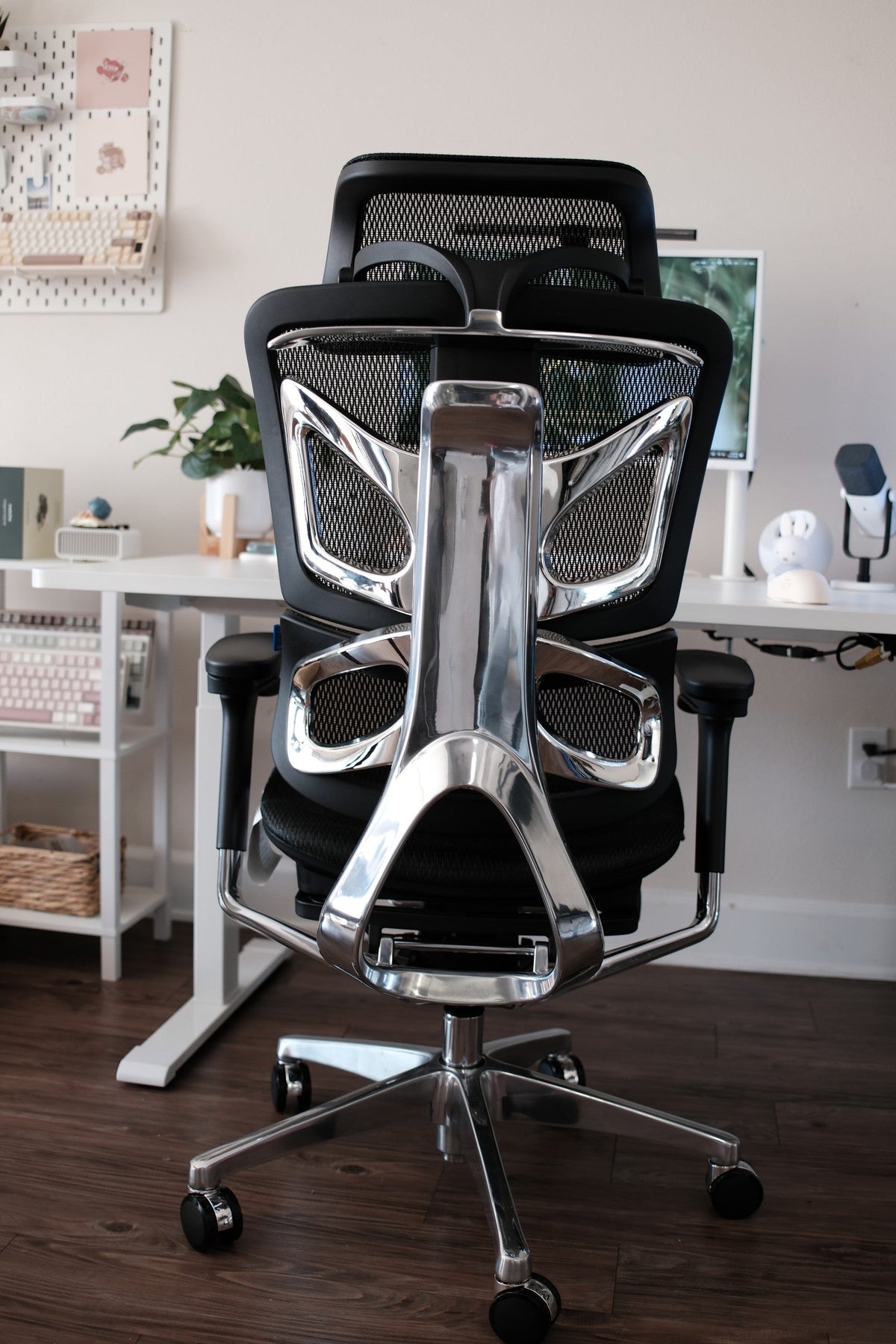
The right ergonomic setup should adapt to your body, support frequent movement, and stay comfortable through a full workday.
Most rolling office chairs have five caster assemblies—one at the end of each arm of a five-point base. That answer can look wrong at first glance, because a twin-wheel caster contains two separate wheel discs. A chair with five twin-wheel casters therefore has five caster assemblies but ten visible wheel discs.
Count the support points before you count the round parts. This distinction makes product descriptions, replacement sets, and safety checks much easier to understand.
Five Casters Does Not Always Mean Five Wheel Discs
In everyday speech, people call the entire rolling unit a “wheel.” Furniture and parts descriptions more often call that unit a caster: a wheeled assembly attached to the chair base. The University of Nebraska Medical Center’s office-chair caster safety guide describes the basic caster components as the mount, stem, and wheel, with additional parts depending on the design.
| What you are counting | Common count on a rolling office chair | How to recognize it |
|---|---|---|
| Base arms or support points | 5 | The spokes extending from the center column near the floor |
| Caster assemblies | 5 | One complete rolling unit mounted at the end of each base arm |
| Wheel discs on single-wheel casters | 5 total | One round rolling element in each caster |
| Wheel discs on twin-wheel casters | 10 total | Two side-by-side rolling elements in each of five caster housings |
This is why a replacement set labeled “five office-chair wheels” may contain five twin-wheel caster assemblies rather than five individual discs. Read the product diagram and model scope instead of relying on the word wheel alone.
Count the Base, Caster Assemblies, and Wheel Discs Separately

You do not need to remove anything to identify the count. Keep the chair unoccupied on a clear, level floor, then work from the center outward.
- Find the center column. Follow it down to the star-shaped base.
- Trace each base arm. Count every separate arm that reaches toward the floor. A typical office-chair base has five.
- Count the mounted units. At the end of each arm, identify the complete caster assembly attached to the base. The caster may swivel, so two units can overlap from one camera angle.
- Look inside each caster housing. Record whether the assembly has one wheel disc or a side-by-side pair.
- Check the chair’s records. A manual, parts diagram, product page, or model-specific support response controls when the visible count is unclear.
A rear or side photograph can hide one caster behind the base. Count from the chair itself when you need to order parts, and never infer attachment size or compatibility from the photograph.
Why Five Support Points Are Common
A rolling chair must remain supported as its casters swivel and the user changes direction. Five base arms place support around the center column without making the base unusually complex. That layout is also reflected in workplace guidance.
The U.S. Occupational Safety and Health Administration notes that chairs with four or fewer legs may provide inadequate support and be prone to tipping, and recommends a strong five-legged base with floor-appropriate casters. The Canadian Centre for Occupational Health and Safety likewise includes a stable five-leg base in its work-chair guidance.
Those recommendations do not mean the number five guarantees a safe chair. Base diameter and strength, caster condition, assembly, floor contact, the chair’s documented capacity, and how the chair is used still matter. The useful conclusion is narrower: five support points are a common, recommended configuration for general office seating, not a substitute for evaluating the complete chair.
A Purpose-Built Exception Is Different From a Missing Caster
Not every seat with office-chair features must use the same undercarriage. Some purpose-built seating may use four or six support points, stationary glides, or another documented base. Judge that design by the manufacturer’s instructions, stated use, and applicable testing—not by retrofitting a wheel count from another model.
A five-point chair with one caster missing is not a designed four-wheel chair. The empty socket changes how the base meets the floor and may indicate damage to the caster stem or base. Keep the chair unloaded and out of use until the exact replacement and the receiving socket have been checked. Do not place a block beneath the empty arm or substitute a furniture wheel that merely looks similar.
If the caster has fallen out, cracked, or no longer stays seated, use the model’s current support path. OdinLake’s office-chair wheel replacement guide explains the separate replacement decision; it should not be confused with simply counting the chair’s wheels.
“Caster,” “Wheel,” and “Five-Point Base” Name Different Parts
Clear terms prevent many ordering mistakes:
- Wheel: the round part that rolls against the floor.
- Caster: the complete rolling assembly attached to the base; it may contain one wheel or two.
- Twin-wheel or dual-wheel caster: one caster assembly with two side-by-side wheel discs.
- Five-point or five-star base: the structure with five arms radiating from the center column.
- Stem or mount: the part that connects the caster assembly to the base.
A chair with wheels may simply be called an office chair, desk chair, or rolling office chair. Task chair usually describes a desk-oriented seating category, while swivel chair describes a rotating seat; neither term guarantees a particular wheel count. When ordering a part, “caster assembly” plus the exact chair model is more useful than “rolling chair wheel.”
The Number Is Only the First Field in a Replacement Check
Knowing that your chair uses five casters tells you the set quantity, not whether a replacement fits. Attachment type, stem dimensions, retention method, installed height, housing clearance, documented load scope, and floor suitability can all change the answer. A five-piece set can still be incompatible with a five-point base.
Before buying, record the chair model and compare the original caster with the exact part listing. If movement is poor but no part is damaged, first determine whether debris is the real problem; OdinLake’s non-destructive caster-cleaning guide keeps that task separate from replacement. If you are comparing complete chairs rather than parts, use the visible base and caster configuration as one field among the current OdinLake ergonomic chair options.
Frequently Asked Questions
Why do office chairs usually have five wheels instead of four?
Most rolling office chairs use five caster assemblies because a five-point base provides support around the center column from more directions. OSHA and CCOHS workplace guidance both recommend a strong or stable five-leg base. Caster condition, base construction, floor contact, and correct use still determine how the complete chair behaves.
Do all office chairs have five wheels?
No. Five caster assemblies are common on general rolling office chairs, but a purpose-built chair may have another documented base or stationary glides. Do not add, remove, or substitute base parts merely to make a chair match the common count.
Does a twin-wheel caster count as one wheel or two?
It is one caster assembly containing two individual wheel discs. In a parts list, a five-caster set usually means five complete assemblies; visually, the chair may show ten round wheel discs.
Is it safe to use an office chair with one caster missing?
Treat a missing caster on a five-caster chair as damage, not as a valid four-caster configuration. Keep the chair unloaded until the correct part and the base socket have been inspected. Stop if the base is cracked, the stem is bent, or the replacement will not remain securely seated.
Can I replace only one office-chair caster?
That depends on the chair maker’s parts guidance and the condition of the remaining set. The replacement must match the attachment, installed height, design, and model scope; otherwise the chair may sit unevenly or roll differently. Inspect all five casters before deciding that the problem is isolated to one unit.
What do you call an office chair with wheels?
Common names include office chair, desk chair, rolling office chair, and sometimes task chair. The wheeled units at the base are called casters. “Swivel chair” describes the seat’s ability to rotate and does not, by itself, confirm that the chair has wheels.