A finish-specific decision guide for checking cure status, casters, grit, chair mats, and early damage before rolling an office chair on coated wood.
The right ergonomic setup should adapt to your body, support frequent movement, and stay comfortable through a full workday.
A rolling office chair can dull, scuff, scratch, or mar a floor coated with water-based polyurethane, but the words “water-based poly” do not tell you how likely that is. The useful answer depends on the exact finish, whether it has fully cured, the condition and suitability of all five casters, the grit in the rolling path, and any chair mat placed over the coating.
A recently refinished floor deserves a different decision from a mature finish that has already carried normal traffic. Do not use a generic internet cure time or a wheel seller’s “hardwood safe” label as permission. Find the finish record first, then follow the current instructions from that finish manufacturer or the flooring professional who applied it.
Identify the coating before you judge the chair
“Water-based polyurethane floor” usually describes a clear finish system applied over wood. It is not a complete floor identity. The wood may be solid or engineered, the coating may be one- or two-component, and the floor may have been finished at a factory or refinished on site. Those differences affect which maintenance, covering, and repair instructions apply.
Even products in the same broad category publish different directions. Minwax Ultra Fast-Drying Polyurethane for Floors, for example, is described as a water-based protective finish for hardwood and gives a two-hour minimum between coats under its stated process. The current US Bona Traffic HD technical data sheet describes a two-component waterborne finish, a two-to-three-hour drying time, walking after 24 hours, and approximately three days to full cure under its stated conditions. One product’s timing does not authorize use of another product.
Build a short identity record before moving the chair onto the floor:
- flooring type and manufacturer, if known;
- finish manufacturer, exact product name, and sheen;
- whether the finish was factory-applied or applied on site;
- date and approximate time of the final coat;
- the installer or refinisher’s written return-to-use instructions; and
- any warranty rules for casters, mats, cleaners, or repairs.
If the only record says “water poly,” treat the finish as unidentified. Ask the contractor, prior owner, builder, or product supplier for the exact product rather than choosing the fastest cure time you can find online. When the coating is new and the product remains unknown, waiting and protecting the area from rolling traffic is the low-risk route.
Keep five timing labels separate
Finish instructions often use several time labels that sound interchangeable but answer different questions. A floor that can be touched or walked on may still be susceptible to concentrated, repeated caster traffic.
| Timing label | What it usually governs | What it does not automatically permit |
|---|---|---|
| Dry to touch | Whether the surface is no longer visibly wet or tacky under the product’s test conditions | Walking, furniture, rugs, mats, or a rolling chair |
| Recoat time | When another finish coat may be applied within that system | Putting the room back into service |
| Light foot traffic | Limited walking under the stated conditions | Repeated rolling or pivoting under an occupied chair |
| Furniture replacement or full use | The manufacturer’s defined return-to-use stage | Every wheel, mat backing, cleaner, or load being compatible |
| Full cure or covering time | When the finish reaches the product’s stated cure level or may be covered | A guarantee against future scratches, wear, dents, or discoloration |
The Bona example makes the distinction concrete: its sheet permits walking after 24 hours but says the finish remains susceptible to scuffing or marring until completely cured and tells users not to replace area rugs before full cure. That is evidence about that named product, not a three-day rule for every water-based polyurethane.
Temperature, humidity, airflow, coat thickness, product mixing, and job-site conditions can affect the actual process. If the room was outside the conditions in the instructions, the floor feels tacky, or the refinisher gave a longer wait, do not substitute your own timetable. Ask the product manufacturer or refinisher when an occupied rolling chair and any proposed mat may return.
Choose one of four routes: go, wait, protect, or stop
| What you know and observe | Route | Next action |
|---|---|---|
| The exact finish is known, its full-use and covering conditions are satisfied, the floor is unchanged, and the caster or mat setup is approved | Go | Establish a baseline, keep the path clean, and inspect the same rolling zone regularly |
| The finish is new, the full-use stage is not reached, the room conditions were uncertain, or the product is unidentified | Wait | Keep the chair and coverings off the area and obtain product-specific instructions |
| The cured floor permits the proposed protection, but repeated chair traffic or caster compatibility remains a concern | Protect | Use a finish-compatible barrier or approved caster arrangement that covers the complete occupied travel zone |
| You see tackiness, cloudy tracks, color transfer, peeling, soft imprints, a changing sheen, or board movement | Stop | Remove rolling traffic, document the area, and contact the finish supplier, refinisher, or flooring professional before cleaning or repairing |
“Protect” is not permission to cover a finish that is still curing. A mat can change airflow and moisture conditions, and an incompatible backing can create a second problem. The finish’s covering restriction comes before the mat decision.
The rolling system matters more than wheel marketing
A caster does not contact the floor in isolation. The occupied chair creates a moving system with five wheels, repeated paths, direction changes, debris, and a finish over a wood substrate. A soft-feeling tread can still carry a hard grain of sand; a smooth wheel can stop rotating and slide; and a wide wheel can still be wrong for the chair or finish.
Evaluate these five exposure fields together:
- Finish state. Is the coating fully cured and free of existing changes?
- Caster specification. Does the chair maker approve the complete caster set, and does the floor or finish guidance permit it?
- Caster condition. Does every wheel roll and swivel freely without cracks, flat spots, embedded grit, or sticky residue?
- Rolling path. Is the entire occupied travel zone clean, or only the visible area beneath the empty chair?
- Use pattern. Does the chair repeatedly pivot in a small zone, cross a threshold, or roll over an edge that changes contact?
OSHA’s computer-workstation guidance says casters should be appropriate for the workstation flooring. That is a compatibility principle, not an endorsement of one tread material or wheel shape. “Polyurethane,” “rubber,” “rollerblade-style,” and “hard-floor caster” are descriptions; none by itself proves approval for your chair, finish, load, or warranty.
Do not change only one or two wheels, force a different stem into the base, add improvised sleeves, or disable the chair’s normal rolling behavior. Caster replacement is also a chair compatibility and stability question. Use the exact chair manual or manufacturer-approved set.
Prepare the chair without exposing the finish
Complete the inspection away from the newly finished area. If the chair is heavy or awkward, get help rather than dragging, tipping, or rolling it across a surface you are trying to protect.
- Preserve the floor record. Save the product sheet, finish batch or receipt if available, last-coat date, installer instructions, and current photographs.
- Confirm return-to-use status. Check separate rules for walking, furniture, full use, and coverings. Ask specifically about an occupied rolling office chair.
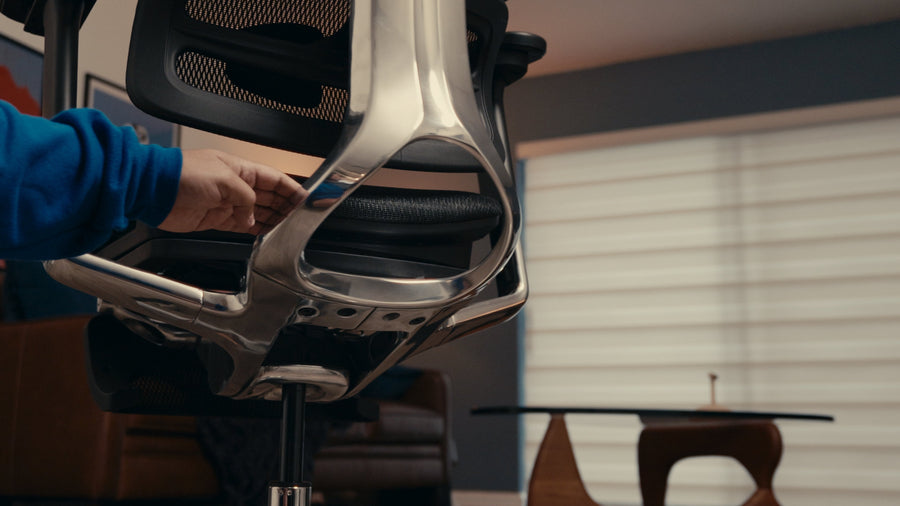
- Inspect the empty chair. Check the base, sockets, stems, axles, treads, and swivel action. A cracked, loose, bent, seized, or mismatched caster is a chair service issue, not a floor test.
- Remove loose debris safely. Use the chair maker’s wheel-cleaning method and the finish maker’s floor-care method. Keep oils, lubricants, solvents, abrasive pads, and wet-cleaning experiments away from the finish.
- Verify the complete set. Confirm chair model, caster part or specification, number of wheels, load rating where published, and floor-use guidance.
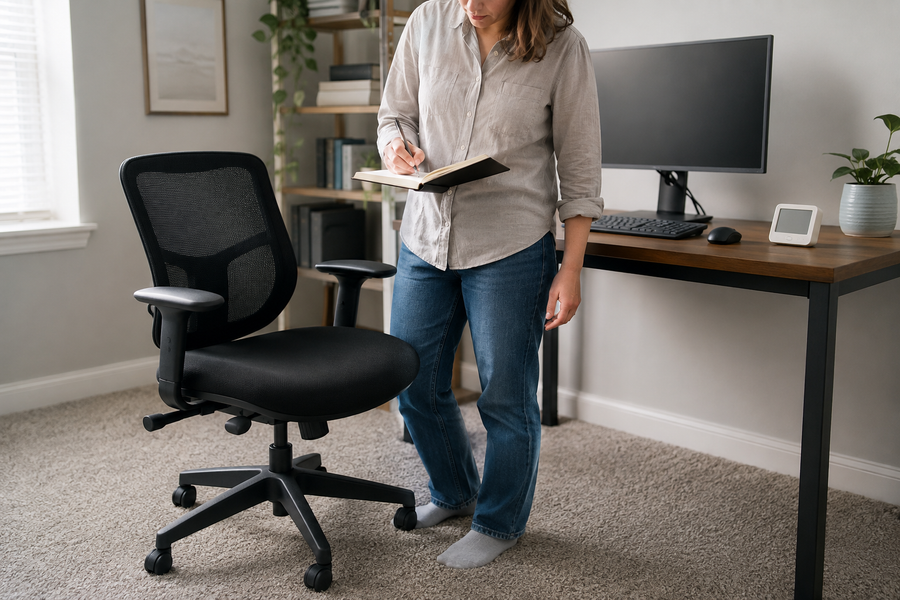
- Map the occupied travel zone. Sit only after permission is established, then note the farthest normal wheel positions when typing, standing, reaching for storage, and leaving the desk.
- Create a visual baseline. In consistent side lighting, photograph the clean floor from two fixed viewpoints before routine use begins.
OdinLake’s office-chair wheel cleaning guide provides a non-destructive general sequence. The floor must still be cleaned only as its own finish instructions allow. Shaw’s hardwood care guidance, for example, emphasizes removing dirt and grit and avoiding harsh chemicals, ammonia, abrasive cleaners, wet mops, and steam mops for its floors. Use that as a product-family example, then follow the directions for your installed finish.
A chair mat is a compatibility layer, not automatic insurance
A mat can separate casters from the coated surface and distribute traffic over a defined area. It can also trap grit underneath, move at the edges, discolor a finish, hold moisture, or cover a finish before covering is permitted. The correct question is not merely “hard-floor mat or carpet mat?” It is whether this exact mat is compatible with this exact, fully ready finish.
Before buying or placing one, obtain written answers to these questions:
- Has the finish reached the stage at which a covering may be placed?
- What is the mat material, including its backing or surface treatment?
- Does the finish or flooring maker prohibit solid, rubber, latex, vinyl, plasticized, adhesive, or other named backings?
- Does the mat maker identify compatibility with site-finished hardwood and the specific coating system?
- Will the mat remain flat and cover every occupied caster position without creating a trip edge?
- Can the underside be inspected and cleaned without dragging the mat across the finish?
Bruce’s hardwood flooring FAQ recommends non-staining, breathable mats for its floors and warns against solid, rubber, or latex backings; it also notes that abrasive jute can scratch. Those are useful failure modes to ask about, but they are not a universal mat specification for every site-applied polyurethane. The finish manufacturer and mat manufacturer must own the compatibility answer for their products.
Once an approved mat is allowed, place it on a clean, dry surface without sliding it. Keep every normal caster position on the mat, make sure the edge does not curl or enter a walking route, and inspect beneath it according to the floor maker’s care schedule. A too-small mat that the chair repeatedly crosses creates an edge event rather than eliminating one.
Read the mark before attempting to remove it
A visible change does not identify its cause. Use observation to choose the next owner, not to improvise a repair.
| What you observe | First safe check | Why to pause |
|---|---|---|
| A loose dark line or particle trail | Stop rolling and inspect the caster treads for transferable debris | Rubbing can turn loose grit into abrasion |
| A repeatable dull or glossy track in side light | Photograph the same path and compare it with an unused nearby area | A sheen change may be surface wear, residue, or a cleaning effect; the remedy differs |
| A soft imprint, tacky spot, or material transfer | Remove the chair or mat without sliding and contact the finish professional | The coating may not be ready or the contacting material may be incompatible |
| Cloudiness or discoloration under a mat | Preserve the mat label and photograph the underside and floor | Moisture, backing chemistry, light exposure, or finish response cannot be separated by appearance alone |
| Peeling, flaking, or finish lifting | Isolate the area and call the refinisher or coating manufacturer | Continuing to roll or abrade can enlarge a coating failure |
| A dent, gap, click, raised edge, or moving board | Keep the chair off the area and request a flooring inspection | The change may involve the wood, joint, installation, or subfloor rather than only the clear finish |
Do not use wax, polish, a magic eraser, abrasive compound, sandpaper, vinegar, ammonia, oil soap, solvent, heat, or a generic scratch remover unless the exact finish instructions prescribe it for that exact condition. Bruce specifically says waxing is not recommended on its urethane-coated hardwood floors. A product that temporarily changes gloss can make diagnosis and later recoating more difficult.
If damage begins, preserve evidence before repair
Move the chair to a non-sensitive surface without rolling it through the affected path. Photograph the whole zone, a close view, the five caster treads, and any mat labels. Write down when the finish was applied, when the chair returned, when the mark first appeared, how the area was cleaned, and whether the change aligns with a caster path or mat edge.
Send that record to the finish manufacturer, flooring contractor, or refinisher. Ask whether the mark should be left untouched for inspection and which approved cleaner or repair process applies. A small scratch in a factory-finished product, a sheen change in a site finish, an adhesion problem, and a dent in the wood may require different owners and methods.
For the broader decision among caster maintenance, a compatible barrier, and floor-specific protection, use OdinLake’s hardwood-floor protection guide. This article remains narrower: it owns the cure and compatibility decision for a water-based polyurethane finish.
Frequently Asked Questions
Will polyurethane casters scratch a polyurethane-coated floor?
They can still contribute to scratches, scuffs, or wear. The shared word “polyurethane” does not establish compatibility. Check the exact finish, full-cure status, caster approval and condition, debris, load, and travel pattern. A soft tread carrying grit can abrade a finish, and a wheel that does not rotate freely can slide.
How long after water-based polyurethane can I use a rolling office chair?
Use the exact product’s return-to-use instructions and ask specifically about occupied rolling traffic. Recoat time, light walking, furniture replacement, full cure, and covering time are different milestones. If the product is unknown or the stated conditions were not maintained, keep the chair off the floor and contact the refinisher or finish manufacturer.
Is a chair mat safe on water-based polyurethane?
Only after the finish instructions permit covering and both product makers confirm compatibility. Verify the mat’s full material and backing, not just the top surface. Keep the floor and underside clean, cover the complete rolling zone, and stop if you see cloudiness, color transfer, adhesion, trapped moisture, or edge movement.
Do rollerblade-style office-chair wheels protect hardwood?
That shape is not a guarantee. Confirm that the complete caster set is approved for the exact chair and suitable under the floor or finish instructions. Wheel material, condition, embedded debris, stem fit, load, and rolling path all matter. Do not force an aftermarket stem or mix wheel types.
Why are there cloudy or dull tracks under my office chair?
The tracks may reflect residue, fine abrasion, a sheen change, a finish that was not ready for traffic, or a reaction involving a mat or cleaning product. Appearance alone cannot separate them. Stop rolling, preserve the lighting and photos, avoid experimental cleaning, and ask the finish professional to identify the approved next step.
Can I repair caster marks without refinishing the floor?
Sometimes a mark is removable residue or a minor condition covered by a manufacturer-approved touch-up method; other changes involve coating wear, adhesion, or the wood itself. Do not sand, wax, polish, or use solvents as a test. Document the mark and obtain the repair method for the exact finish before altering it.