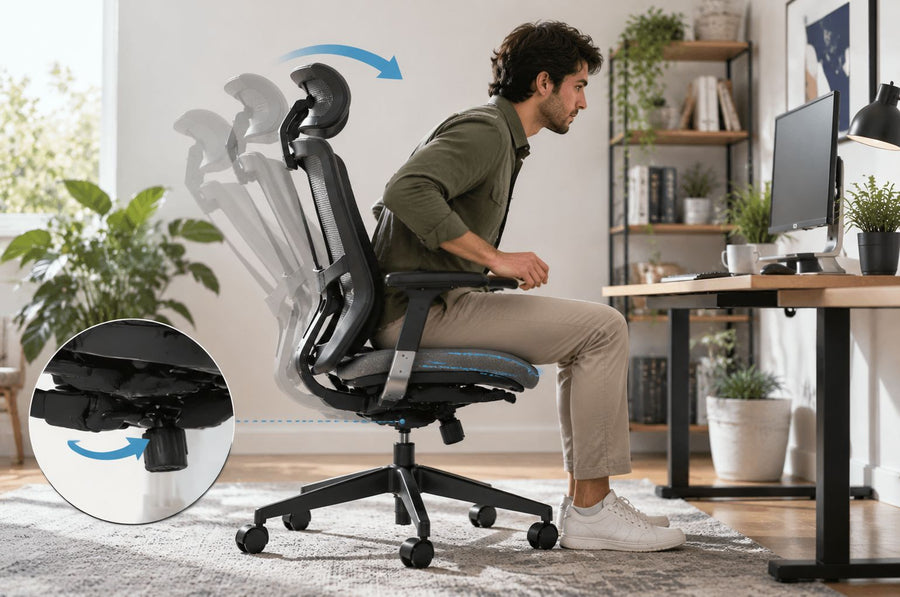
The right ergonomic setup should adapt to your body, support frequent movement, and stay comfortable through a full workday.
To measure an office chair gas cylinder for replacement, record more than its diameter. Start with the chair model and revision, then document the activation style, outer body diameter, defined overall length, stroke, installed height range, and the way the cylinder meets the base and seat mechanism. A replacement can enter both sockets and still leave the chair too tall, too low, or unable to activate correctly.
Do not dismantle a working chair only to take measurements. The safest order is: identify the chair, check its current manual or parts listing, record the assembled chair, and ask the manufacturer to confirm the part. Measure a removed cylinder only if it is already out under an approved service procedure. Never drill, cut, heat, open, or manually force a sealed gas lift through its travel.
Start With the Chair Label, Not the Tape Measure
A model number can resolve details that a ruler cannot see. Look under the seat, beneath the base, or on the product label for the brand, model, revision, serial number, production date, and any gas-lift part number. Photograph the entire label and one wider image showing where it appears on the chair.
Next, check the manufacturer’s current product, parts, and support pages. OdinLake owners can begin with the official assembly guides, which route users to model-specific manuals for current chairs. A manual may show whether the chair uses a conventional top-activated lift, a cable-operated mechanism, a sleeve, or another model-specific interface. That information is often more decisive than a visible tube diameter.
If the chair is sinking, stuck at one height, or failing to respond to the control, confirm the failed component before ordering. Use the separate sinking-chair diagnostic to distinguish a likely lift problem from a lever, cable, actuator, or mechanism issue. Measurement answers “what fits”; it does not prove “what failed.”
Record the Installed Chair Before Anything Comes Apart

Put the unloaded chair on a hard, level floor. Remove a loose seat cushion if it is not part of the chair, but leave structural covers and components in place. Use the same floor point and the same seat reference for every reading. A practical reference is the floor directly below the center of the seat to the top of the seat at that center point; write down exactly where you measured so another person can reproduce it.
- Set and record the lowest usable seat height. Sit normally to settle the chair, stand up, then measure the unloaded chair without changing the control.
- Set and record the highest usable seat height. Raise the empty seat through the normal control, let it stop naturally, and measure from the same points.
- Photograph the center column from two sides. Include the lower edge of the seat mechanism, the base hub, and any telescoping plastic shroud.
- Measure visible protrusion. If part of the metal body extends below the base hub, record that exposed distance without crawling beneath a loaded or unstable chair.
- Note functional clearance. Check whether the current lowest position clears the base and whether the highest position suits the user and desk.
Installed seat height is not the same as cylinder length. The seat cushion, control mechanism, base hub, taper insertion depth, and casters all contribute to the final measurement. The installed record is therefore a result check: it tells you what range the replacement must preserve.
Build a Seven-Field Cylinder Record
Use one worksheet, note, or support email to keep the following fields together. Leaving the state or endpoints undefined is a common source of wrong-part orders.
| Field | What to record | Why it matters |
|---|---|---|
| 1. Chair identity | Brand, model, revision, serial number, and production date | Separates visually similar chairs and revisions |
| 2. Cylinder identity | Part number, label text, and manufacturer-confirmed model list | Provides the strongest direct match |
| 3. Activation style | Top button, side activation, cable interface, or another documented mechanism | The chair control must operate the lift correctly |
| 4. Outer body diameter | Diameter of the straight structural tube, excluding a plastic cover | Helps determine base-hub fit but does not prove full compatibility |
| 5. Defined length | Manufacturer’s compressed and extended dimensions, including stated endpoints | Controls installation geometry and final chair height |
| 6. Stroke or travel | Published movement between compressed and extended positions | Influences the available height-adjustment range |
| 7. Interface and rating | Taper, shoulder, insertion details, class, documented capacity, and model scope | Checks structural and functional suitability as a system |
A component manufacturer’s gas-cylinder selection guide likewise treats class, stroke, tube dimensions, compressed and extended length, load capacity, and interface compatibility as separate factors. That is useful corroboration for the field list; the chair manufacturer’s specification still controls the actual replacement decision.
Measure Only the Surfaces That Define Fit
If the original cylinder is already safely removed, clean loose dust with a dry cloth and place the sealed part on a stable surface. Keep the actuator away from tools and hands. A ruler or tape can record overall length; a caliper is more suitable for diameter. Do not clamp the part in a vise or press the actuator pin to create a second length reading.
Outer body diameter
Measure across the straight metal pressure tube at a clean, undamaged section. Do not measure a telescoping plastic shroud, decorative sleeve, flared shoulder, or tapered end. Take readings in two directions. If they differ materially, the tube may be damaged or you may be measuring the wrong surface; stop and ask support rather than averaging an uncertain result.
Overall length
Write down both endpoints, the cylinder’s state, and whether any cover is included. For example: “unloaded, naturally extended; lower metal end to top of actuator; plastic shroud excluded.” A bare number such as “14 inches” cannot be compared safely with a seller’s measurement unless both use the same endpoints and state.
Do not attempt to produce a compressed-length measurement by hand. A gas spring contains stored pressure, and the force required is not a casual bench test. Use the original manufacturer’s published compressed and extended lengths or obtain them from support. A gas-spring manufacturer’s technical FAQ explains that gas springs are filled with compressed nitrogen and warns against unauthorized opening or modification.
Stroke, insertion depth, and protrusion
Stroke is the difference in piston travel between the defined extended and compressed positions; it is not the full cylinder length. Use a published stroke specification rather than trying to compress the part. Also record any manufacturer-specified taper or insertion dimension. Your before-disassembly photo and the visible distance below the base can help support compare how the original sat in the chair, but these installed observations do not replace socket specifications.
Compare the Replacement as a System
Do not approve a candidate because one number matches. Place the original specification and candidate specification side by side, then resolve every row.
| Compatibility check | A match should establish | What a mismatch can cause |
|---|---|---|
| Base and upper socket | Correct documented interfaces and seating depth | Loose fit, incomplete seating, or damage to a hub or mechanism |
| Activation | Chair control reaches and releases the correct actuator | No height response or a control that remains partly open |
| Length and stroke | Required lowest position, highest position, and travel | A chair that fits physically but sits too high, too low, or has the wrong range |
| Class and capacity | Chair-maker-approved rating for the exact model and intended use | An unsupported structural or performance assumption |
| Model and revision scope | The seller or manufacturer explicitly names the chair | A part intended for a visually similar but different product |
“Universal” should be treated as a search term, not a completed compatibility check. Common diameters and tapers exist, but the combination of geometry, activation, rating, and final seat height determines whether the chair works as intended.
Use OdinLake’s O-Series Part as a Worked Example
Checked August 27, 2026, OdinLake’s current O-series replacement gas-lift listing names the O1, O2, and O3 office chairs. It lists a 120 mm (about 4.7 inch) stroke, 50 mm outer diameter, 250–365 mm adjustable length, and Class 4 construction.
That listing demonstrates how a useful fit record combines model scope with dimensions. It does not mean that every cylinder with a 50 mm body fits those chairs, nor that the part is appropriate for an OdinLake L-series chair or another brand. The named models are the first compatibility boundary; the specification values describe the part inside that boundary.
For an OdinLake chair with a missing or unreadable label, send clear photos of the full chair, underside mechanism, base hub, center column, and any remaining label to OdinLake support. Include the order number when available and the installed lowest and highest seat-height readings. Support can identify the model and current service part without asking you to experiment with the sealed lift.
Know When Measurement Is Not Enough
Stop the fit decision and obtain model-specific help when:
- the chair or cylinder label is missing and several models share the same appearance;
- the activation system is side-operated, cable-driven, recessed, or unfamiliar;
- the base hub or upper socket is cracked, oval, loose, or visibly deformed;
- the cylinder is dented, bent, leaking, heavily corroded, or stuck in an unsafe position;
- published listings use different measurement endpoints or do not define compressed and extended states;
- a seller confirms only diameter while avoiding questions about model, stroke, activation, or rating; or
- changing the seat-height range could prevent the intended user from placing both feet securely on the floor.
A measurement record is meant to reduce uncertainty, not make an uncertain part look precise. If one critical field remains unresolved, keep the chair unloaded and confirm the part before ordering or installing it.
Save a Fit Record Before You Order
Keep one final page with the chair label photos, model and revision, current part number, installed lowest and highest seat heights, candidate part link, all defined dimensions, activation style, and the manufacturer or support confirmation. Add the date because listings and service parts can change.
After installation by the approved method, compare the chair with that original record. The base should sit level, the control should return normally, and the chair should raise, lower, hold height, and swivel without new looseness or scraping. A matching part number is valuable; a matching, safely functioning chair is the final check.
Frequently Asked Questions
Are office chair gas cylinders universal?
No. Many cylinders share common-looking diameters and tapered connections, but activation style, length, stroke, insertion geometry, class, capacity, and model scope can differ. Use the exact chair model or obtain manufacturer confirmation instead of relying on “universal” alone.
What size gas cylinder do I need for my office chair?
You need a part that matches the chair model, both interfaces, activation style, outer body diameter, defined compressed and extended lengths, stroke, and approved rating. The correct size is a specification set, not one diameter.
Can I measure an office chair cylinder without removing it?
You can collect much of the useful evidence without removal: chair and cylinder labels, installed lowest and highest seat heights, control type, photos of both interfaces, and visible body or protrusion measurements. Exact hidden geometry should come from the manual, parts listing, or support—not from dismantling a working chair solely to measure it.
Should I measure a gas cylinder fully extended or compressed?
Record both manufacturer-defined dimensions when they are available and name the endpoints. If a removed cylinder naturally rests fully extended, you may record that state without actuating it. Do not try to compress the sealed part by hand; obtain the compressed length and stroke from the manufacturer.
What does stroke length mean on an office chair cylinder?
Stroke is the designed piston travel between defined compressed and extended positions. It influences the available height-adjustment range, but the chair’s actual seat-height change also depends on the mechanism, base, insertion depth, seat construction, and casters.
Is the gas-lift class the same as the cylinder size?
No. Class describes a construction or performance category; size describes geometry such as diameter, length, and stroke. Two parts described with the same class can still have different dimensions or interfaces, and two similarly sized parts may not carry the same approved rating.