A material-aware method for unrolling a chair mat, using only approved room conditions and distributed weight, then testing whether it is actually safe to use.
The right ergonomic setup should adapt to your body, support frequent movement, and stay comfortable through a full workday.
To flatten a rolled office chair mat, first identify the mat’s material, intended floor, correct side, and manufacturer instructions. Let the packaged mat reach the maker’s required room conditions, clear a clean and level surface, and unroll it slowly without folding or forcing a cold sheet. If the instructions permit weights, use broad, flat objects at the raised areas and keep the chair off the mat until it passes a flatness check.
Do not treat a hair dryer, direct sun, hot water, an iron, or a heat gun as a universal shortcut. Some vinyl-mat instructions allow specific forms of gentle warming; other products have different limits. The product label or model-specific guide decides what is allowed. A mat with cracks, stress whitening, a sharp crease, chips, separation, or a persistent raised edge needs support or replacement—not more force.
Identify the Mat Before You Try to Flatten It
“Chair mat” describes products that can behave very differently. A flexible vinyl/PVC mat may arrive tightly rolled and need time to relax. A particular polycarbonate mat may unroll ready for use. A foldable mat is intended to open along designed joints. A rigid glass mat should not be bent at all. Appearance alone is not enough to select a method.
Find the carton label, care sheet, order record, or support page and record four facts:
- Material and model: Do not guess from transparency. Clear vinyl and clear polycarbonate are not interchangeable instructions.
- Floor application: Confirm whether the mat is designed for hard floor, carpet, or the exact pile range beneath it.
- Working side: Identify which surface faces up and which backing faces down. On one current Floortex guide, carpet versions have a gripper back while hard-floor versions have a smooth back; that is an example of product-specific orientation, not permission to generalize every clear mat.
- Unrolling limits: Note the required temperature, whether weights are allowed, the stated relaxation time, and any prohibited heat source.
Published instructions show why these details matter. ES ROBBINS’ vinyl-chair-mat guidance says its mats should reach at least 68°F (20°C), may need as long as 72 hours to flatten, and must not be exposed to extreme heat. A Floortex chair-mat guide says its polycarbonate mats go flat immediately while its PVC mats take longer to unroll and flatten. Those examples support one rule: follow the instructions for the mat you own, not a material hack copied from another product.
Use This Unroll-to-Flat Sequence
The procedure below is intentionally conservative. Where the mat maker specifies a different sequence, temperature, duration, orientation, or number of people, the exact product instructions take priority.
- Park the chair somewhere else. Remove the chair, cables, and loose objects from the work zone. Choose a space where no one needs to walk over the mat while it relaxes.
- Prepare the receiving surface. The floor should be level, clean, dry, and compatible with the mat. Remove grit rather than trapping it under a weighted sheet. If the floor itself is buckled or uneven, correct that problem before judging the mat.
- Let the package acclimate as directed. Keep the roll in the maker-approved room conditions for the stated period. Do not force a mat that is still unusually stiff from cold storage or delivery.
- Remove the band without cutting toward the mat. Control the roll as the restraint comes off. A tightly rolled sheet can spring open; use a second person when the instructions or the mat’s size call for one.
- Unroll slowly onto the flat surface. Support the sheet as it opens. Do not fold it backward, stand on the roll, or make a hard reverse crease in an attempt to cancel the curl.
- Turn the correct surface upward. Use the label or manual to confirm orientation. A carpet gripper belongs against its approved carpet, while a smooth hard-floor backing must remain free of grit.
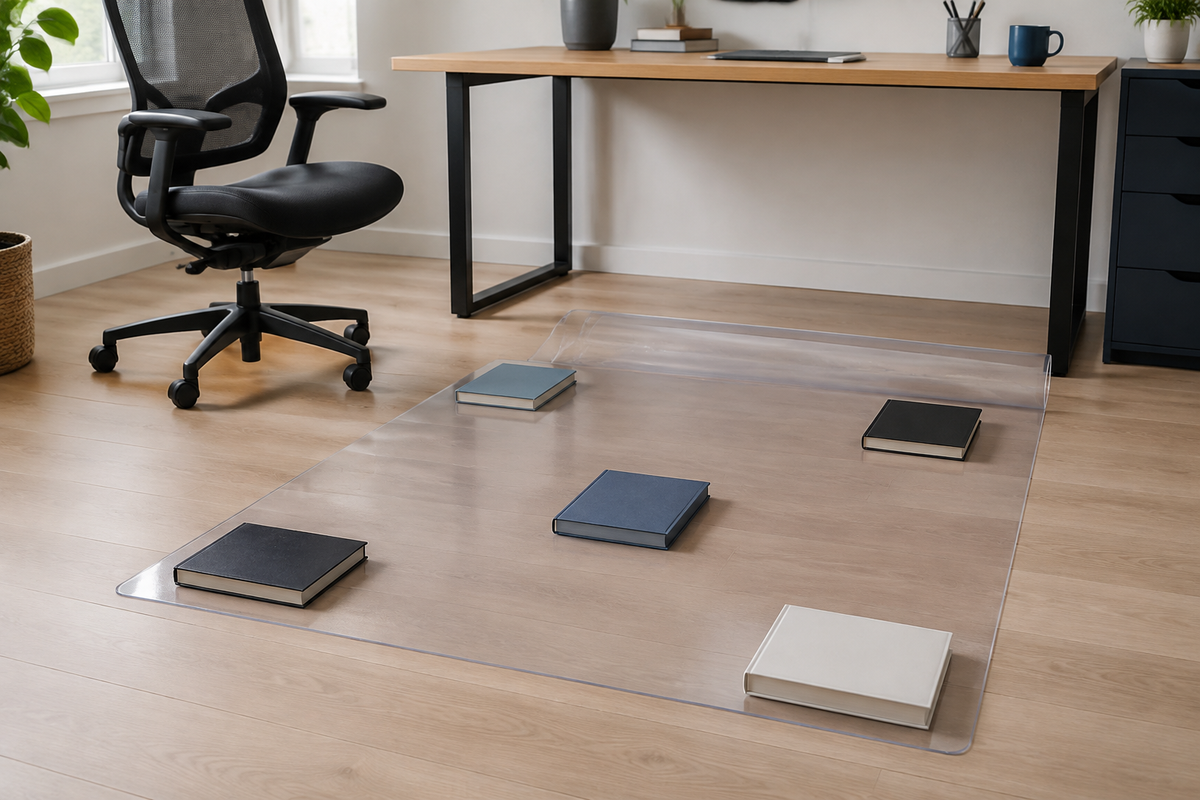
- Add only an approved, distributed load. If the instructions permit weights, use broad, flat objects such as books at the named locations. Keep objects stable, dry, and away from walkways. Do not use a desk leg, chair caster, dumbbell edge, or another small contact point that concentrates force.
- Wait for the maker’s stated time. Do not invent a universal “overnight” promise. Room conditions, material, roll tightness, storage history, and product design affect the result.
- Remove every weight and inspect. The mat has not passed merely because furniture is holding it down. It must remain acceptably flat after the temporary load is removed.
Use Heat Only When the Exact Instructions Allow It
Search results commonly recommend sun, hair dryers, irons, steam, hot water, or heat guns as though all plastic chair mats respond the same way. They do not. Heat can soften a flexible product, but the wrong temperature or distance can also distort a surface, create a local wave, damage a floor finish, or exceed the mat’s care instructions.
For example, ES ROBBINS publishes a controlled hair-dryer option for its vinyl chair mats and simultaneously warns against extreme heat. That is permission for those products under those stated conditions; it is not a blanket method for an unknown mat. If your documentation does not explicitly authorize assisted heat, use the specified room-temperature method or contact the manufacturer.
Never use an iron, heat gun, boiling water, open flame, heated pan, or improvised hot object on a chair mat. Do not warm a mat while it is resting on a floor that could be affected by heat or trapped moisture. If a manufacturer-approved warming step is unclear about surface protection, location, or equipment limits, stop and ask support before proceeding.
Decide Whether the Mat Is Actually Flat
A visual check from standing height can miss a raised perimeter that catches a caster or a toe. Test the mat in stages, without asking chair weight to finish the flattening job.
- Look along the perimeter at floor level. Check every corner, the lip if the mat has one, and the area that was at the center of the roll. Use indirect light to make gaps easier to see.
- Press and release raised areas by hand. Apply light pressure with an open palm, then let go. A section that immediately springs back into a high curl has not passed.
- Check the whole sheet for damage. Look for stress whitening, cracks, a hard crease, split edges, chips, bubbles, or layer separation. Do not continue if the edge has become sharp.
- Confirm the underside and floor are still clean and dry. Lift according to the instructions; do not drag the mat across grit. Inspect for marks, residue, trapped moisture, or a reaction with the finish.
- Run an empty-chair test. Place the chair with all casters well inside the mat. Roll it slowly through the intended work area while observing from a safe position. Stop if a caster catches an edge, the mat rocks, or a section rises.
- Run a short occupied test only after the empty test passes. Sit down under control and make the normal small movements used at the desk. Every caster should remain on the usable area, with no new lift, slide, buckling, crack, or noise.
A practical pass means the mat stays flat without temporary weights, presents no raised or sharp edge, shows no visible structural damage, and remains stable through the chair’s normal path. It also must be the correct product for the floor below. If the mat is flat but slides as a complete sheet, that is a separate interface problem; do not try to solve it by adding more weight.
Why a Chair Mat Can Curl Again
| What happens | What it suggests | Next decision |
|---|---|---|
| A new rolled mat slowly improves after unpacking | Temporary roll memory may still be relaxing | Continue only within the maker’s stated conditions and time window |
| One edge rises again as soon as books are removed | The mat has not completed its approved relaxation process, or the deformation may be persistent | Recheck instructions; contact support rather than escalating force or heat |
| The mat lies flat elsewhere but buckles in the workstation | The floor is uneven, the carpet/pile rating is wrong, or the mat is incompatible with the surface | Diagnose the surface and product match; flattening alone will not correct it |
| An edge lifts after casters repeatedly cross it | The mat may be too small, misplaced, or permanently deformed | Map the occupied caster path and replace the mat if it cannot contain that path |
| White lines, cracks, chips, splits, or a sharp crease appear | Visible material damage rather than harmless curl | Stop using the mat and follow the manufacturer’s warranty or replacement route |
Orientation can also make a usable mat behave incorrectly. The Floortex guide, for example, distinguishes smooth backs for hard floors from gripper backs for carpet. If you cannot identify the intended down-facing surface, do not decide by gloss alone; find the model instructions. For broader floor-protection choices, OdinLake’s guide explains how to protect hardwood floors from an office chair without assuming that every mat or caster is finish-compatible.
Stop Flattening and Replace or Escalate When Needed
More time and more weight are not always the answer. Take the mat out of service and contact the seller or manufacturer when:
- the material or model cannot be identified and a heat-assisted method would be required;
- the maker’s maximum relaxation window has passed and an edge remains raised;
- the mat is cracked, chipped, split, delaminated, stress-whitened, or sharply creased;
- it is meant for a different floor type or carpet pile;
- it becomes flat only while furniture or concentrated weights remain on it;
- it buckles under normal caster load, exposes a trip edge, or lets a caster catch;
- the floor shows staining, finish change, moisture, residue, indentation, or movement beneath the mat.
Before contacting support, photograph the full mat and the problem area, keep the product label and order number, and record the room conditions, time unpacked, method used, and visible changes. That evidence makes a warranty or troubleshooting conversation more useful than simply reporting that the mat “won’t flatten.”
Once the mat passes, keep its underside and the caster treads free of grit. OdinLake’s separate procedure for cleaning office chair wheels covers the caster task without requiring wheel removal.
Frequently Asked Questions
How long does an office chair mat take to flatten?
Use the time stated for the exact mat. Published guidance varies: some vinyl products may take up to 72 hours, while certain polycarbonate products are described as ready immediately after unrolling. Temperature, material, storage, and roll tightness make a universal deadline unreliable.
Can I use a hair dryer to flatten a chair mat?
Only if the exact chair-mat instructions authorize it and you can follow their temperature, distance, duration, location, and appliance-safety limits. A hair-dryer method published for one vinyl product does not prove that heat is safe for another mat or for the floor beneath it.
Which side of a clear office chair mat goes down?
Check the model instructions rather than judging by transparency or shine. Many carpet-specific mats place their approved grippers toward the carpet, while hard-floor versions may use a smooth backing. Never put pointed carpet cleats against a hard floor.
Should I roll the chair mat backward to remove the curl?
Do not reverse-roll or make a hard counter-crease unless the manufacturer specifically directs that method. Forced reverse bending can create a crease or visible stress. Slow unrolling on a flat surface with only approved distributed weight is the more controlled default.
Why does my office chair mat keep curling at the edge?
The mat may still have roll memory, may be on the wrong side or surface, may be too small for the caster path, or may have permanent deformation. Remove the chair, inspect the mat on a level surface, compare the result with its instructions, and separate flattening from sliding or floor-compatibility problems.
Can I keep using a chair mat with one corner raised?
Not while the corner can catch a caster or foot. Remove the chair and either complete the maker-approved flattening process or replace the mat. Stop immediately if the raised area includes a crack, sharp edge, whitening, separation, or a crease that returns after temporary weight is removed.