The right ergonomic setup should adapt to your body, support frequent movement, and stay comfortable through a full workday.
A rolling office chair can damage vinyl plank flooring, but damage is not inevitable and “vinyl” is not a single set of rules. The practical risk depends on the exact flooring product, installation, caster contact, debris, repeated travel path, and anything placed between the chair and floor. Before buying wheels or a mat, identify the floor, read its current care and warranty documents, record the existing condition, and separate a removable mark from a scratch, indentation, moving joint, or chemical discoloration.
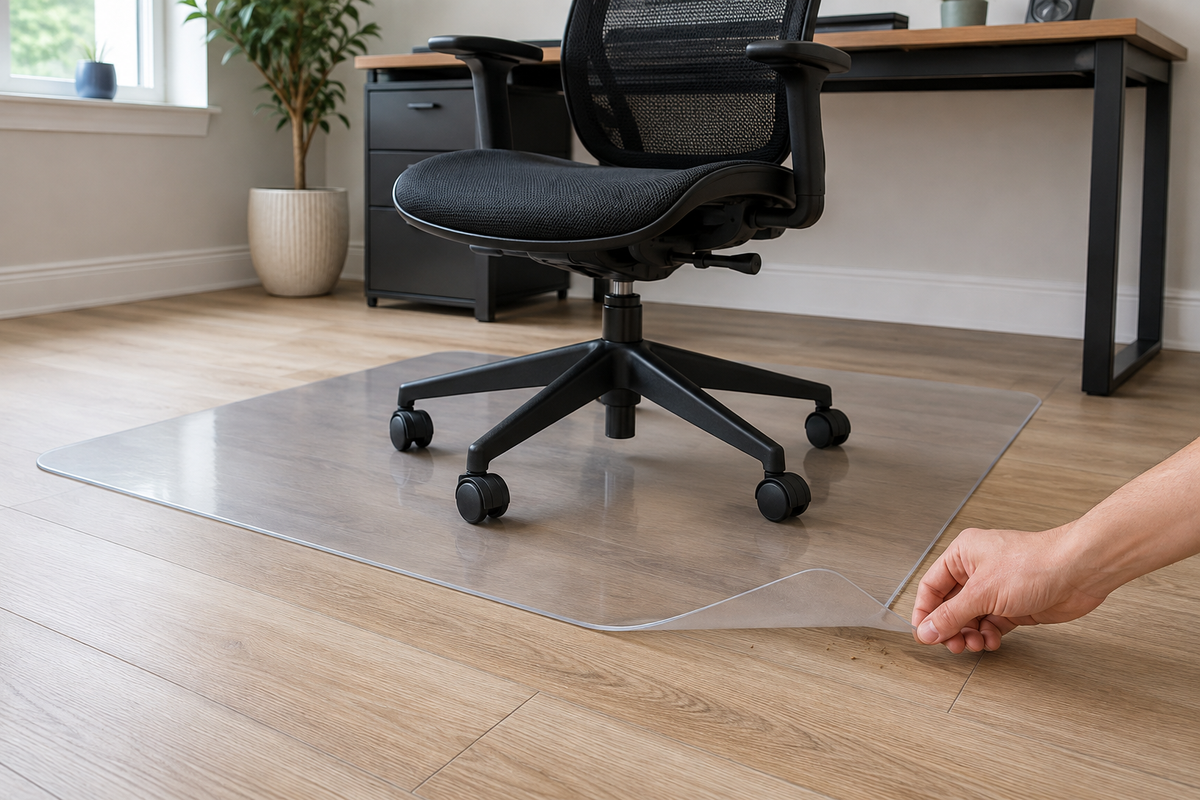
For many installations, the lowest-uncertainty route is a rigid, flat chair mat made for hard floors, with a backing the flooring manufacturer allows and enough usable area to keep every caster on the mat during normal work. That is not a universal prescription: some vinyl-floor documents specify caster dimensions or materials, some require a protective mat, and some prohibit rubber-, latex-, or coco-backed mats because they may stain the surface. The exact product document controls.
First, Identify the Change You Are Trying to Prevent
“Damage” is too broad to guide a useful response. Move the unloaded chair away without dragging it, remove loose dirt using the floor maker’s approved method, and inspect the area in ordinary light and low-angle light. Compare the main rolling lane with an area beneath the desk that receives little chair traffic.
| What you observe | What it may represent | What to do now |
|---|---|---|
| A dark or pale transfer mark that changes during approved cleaning | Residue from a caster, mat, shoe, or other contact material | Stop rolling, photograph it, and use only the cleaner and method named for the exact floor; note what was touching the area |
| Fine arcs, scratches, or a dull repeated lane | Abrasive grit, a rough tread, dragging caster, or cumulative surface wear | Keep the occupied chair off the area; inspect the floor and all five caster treads before adding a barrier |
| A localized depression or change in surface profile | Concentrated or sustained loading, depending on the product and substrate | Remove the rolling load and ask the flooring manufacturer or installer how that product should be assessed |
| Clicking, gapping, a raised edge, a chipped joint, or movement under load | A floor-system or installation condition that cannot be diagnosed from the chair alone | Stop crossing the area and obtain flooring guidance before testing again |
| Haze, yellowing, or a color change beneath a mat or rug | Possible backing, additive, moisture, heat, or maintenance interaction | Remove the covering as its instructions permit, preserve its label, and contact the flooring maker before applying a solvent or polish |
| No visible change | A usable baseline—not proof of future compatibility | Record the condition, verify the floor rules, and install one documented protection system before long-term rolling |
These observations are triage categories, not remote diagnoses. A surface mark and a worn wear layer can look similar in a photo; a clicking joint may involve the plank, locking profile, subfloor, expansion space, or another installation condition. Do not continue rolling simply to make the symptom easier to reproduce.
The Floor’s Product Documents Decide What Is Compatible
Find the manufacturer, collection, SKU or style number, installation method, installation date, and installer if possible. Useful records include a leftover carton, purchase invoice, landlord or builder file, product label, and warranty registration. In the current care guide and warranty, search for caster, rolling chair, rolling load, chair mat, floor protector, rubber, latex, and rug backing.
Current manufacturer instructions show why a generic answer is unsafe:
- Mannington’s ADURA Rigid care instructions call for wide-bearing, non-staining protectors, specify a minimum flat caster surface width for movable furniture, and direct users to place a rigid protective chair mat under rolling chairs and rolling loads.
- Mannington’s ADURA Flex instructions include a similar caster-contact provision but also warn against rubber-backed, latex-backed, and coco-fiber mats for that product.
- The July 2025 SLCC SPC/WPC/LVT care guide requires protective chair mats for rolling chairs, specifies a firm, smooth-backed mat made for hard floors, rejects studded carpet mats on vinyl planks, and tells owners to keep grit from collecting beneath the mat.
- Shaw’s luxury-vinyl care guidance emphasizes removing abrasive grit, using felt protectors and wide load-bearing bases or rollers, and choosing mats without latex or rubber backing to reduce the possibility of discoloration.
These are product-family examples, not a combined industry specification. Do not take a caster width from one manufacturer, a backing rule from another, and a chair-mat requirement from a third to invent a “universal LVP setup.” If the floor cannot be identified, ask the installer, property owner, builder, or flooring retailer for written guidance. Until then, avoid direct occupied rolling over an area already showing change and avoid unverified rubber or latex backings, carpet-mat studs, adhesive films, solvents, steam, polish, and repair compounds.
Make a Baseline Before You Change the Setup
A useful baseline lets you distinguish an existing condition from something that appears after a new mat or caster set. It also gives a flooring or chair support team the information needed to answer a compatibility question.
- Photograph the floor. Take one wide view and close views of the main rolling lane, mat edge, plank joints, and any mark. Add a ruler beside—never taped to—the affected area when scale matters.
- Record the contact materials. Note the floor product, chair model, current caster type, mat or rug brand, backing description, and how the floor was installed. Photograph labels rather than relying on appearance.
- Clean dry debris first. Follow the floor document. Remove particles from the rolling area and from beneath any approved mat without dragging the mat across them.
- Inspect every caster. With the chair empty and stabilized as its manual allows, examine all five treads and housings. Embedded grit, a flat spot, a split tread, looseness, or a wheel that does not swivel can change the contact from rolling to scrubbing.
- Mark the real travel. Note where the casters go when you type, reach side storage, roll back, stand, and leave. The relevant area is the entire occupied path, not just the chair’s parked footprint.
For a detailed non-destructive cleaning procedure, use OdinLake’s office-chair wheel cleaning guide. Stop cleaning and move to service or replacement guidance if a caster remains cracked, loose, bent, flat-spotted, grinding, or unable to roll and swivel normally.
Match the Protection to the Failure Path
One accessory cannot solve every risk. Work from the observed failure path and obtain the required approval from each product owner.
If grit or repeated surface wear is the concern
Keep both contact surfaces clean. A mat placed over particles can trap the abrasive material where it is difficult to see, while a clean “soft” caster can pick up new grit at the edge of the rolling area. Use the floor maker’s approved dry cleaning and cleaner instructions, and clean the mat underside as its maker directs. Reject a mat that cannot be lifted or maintained without scraping the floor.
If concentrated caster contact is the concern
Follow the floor’s requirements for caster width, tread type, load distribution, or a protective mat. Then check the chair maker’s requirements for attachment, stem, mounted height, base clearance, complete-set rating, and intended surface. Changing wheel diameter can change seat height and the way a chair accelerates or crosses an edge. “Rollerblade style,” “soft,” and “rubber” are descriptions—not compatibility evidence.
Rubber deserves particular caution: some vinyl-floor instructions warn that rubber- or latex-backed products can discolor their surface. That does not prove that every item marketed as a rubber caster will stain every LVP floor, but it does mean a broad “rubber is always safest” recommendation is not supportable. Ask both manufacturers about the actual material.
If a chair mat is required or selected
Choose a mat explicitly intended for hard floors and compatible with the exact vinyl product. Verify that it is rigid or firm enough for the occupied rolling load, lies flat, has a smooth non-studded underside, uses an allowed non-staining backing, and covers the full travel of all five casters. A carpet mat with cleats, a curled edge, or a mat that ends in the main push-off zone creates a different hazard.
A decorative rug or pad is not an automatic substitute. Its backing may contain a material the vinyl maker restricts, a thick pile can catch small casters, and a flexible layer may not distribute a rolling load the way a specified rigid mat does. Use a rug only when the floor, rug, backing, and chair movement are all documented as compatible.
If a joint is moving or the surface is already changing
Do not treat a new mat as a repair. Stop the repeated load, document the condition, and ask the floor manufacturer or installer to evaluate the floor system. Adding adhesive, heat, filler, a heavy plate, or an unapproved cleaning chemical can hide evidence and may complicate a product-specific repair.
Run a Controlled Before-and-After Check
The goal of the check is modest: verify that the selected setup stays flat, contains the real travel path, and does not create an immediate visible or functional problem. It cannot establish lifetime durability or warranty coverage.
- Start clean and dry. Confirm the floor, caster treads, and permitted mat underside are free of visible grit and moisture. Do not test over a joint that is already raised, clicking, gapped, or chipped.
- Record the starting view. Photograph the same two or three locations in consistent light. Note the installed mat or caster set and the manufacturer documents used to approve it.
- Place the unloaded chair. All five caster assemblies should contact the same flat surface. The mat should not rock, slide, curl, bridge an uneven joint, or trap a cable.
- Make a slow empty-chair pass. Roll through the normal path. Stop if a caster binds, drags, catches an edge, or makes the chair tip or accelerate unexpectedly.
- Repeat the normal path while seated. Type, reach to each side, roll back, stand, exit, and return at ordinary speed. Keep feet clear of the casters. Every caster should remain on the mat if a mat is the approved barrier.
- Inspect immediately. Look for new transfer, arcs, haze, debris, mat movement, edge lift, clicking, or joint change. Compare with the baseline rather than memory.
- Change only one failed variable. If the issue is debris, clean it; if the mat is too small, replace or reposition it as allowed; if a caster is damaged, resolve that caster set. Do not change the floor cleaner, mat, and wheels at the same time and then guess which change mattered.
A passing check means the chair moves predictably, the mat remains flat, all intended contact stays within the protected area, and the inspection reveals no immediate new change. Recheck after the first normal work session because a short test cannot reveal every cumulative interaction.
What the Test Does Not Prove
- It does not prove the wear layer will remain unchanged for the life of the floor.
- It does not override a warranty requirement for a chair mat or specified protector.
- It does not prove that an unidentified backing will not discolor the vinyl over time.
- It does not diagnose the cause of a moving joint or indentation.
- It does not make a caster compatible with a chair when the stem, height, clearance, or rating is wrong.
- It does not make a mat large enough if a caster leaves it during real work.
Keep labels and receipts for the floor, mat, and caster set. If a condition develops, record when it was first noticed, where it appears relative to the rolling path, and what changed immediately beforehand. Those facts are more useful than a generic claim that an accessory is “vinyl-safe.”
If the Vinyl Plank Floor Already Has a Mark
Stop direct rolling and preserve the scene before attempting a fix. Photograph the floor in normal and low-angle light, the caster treads, the underside and label of any mat or rug, and the surrounding joints. Record the cleaner previously used and whether heat, direct sun, moisture, or a recent accessory change was involved.
Use only the cleaning or repair method supplied for the exact flooring product. Do not begin with acetone, alcohol, adhesive remover, abrasive pads, steam, wax, polish, heat, glue, tape, or a color-matched filler. A method that removes transfer from one finish can haze, soften, stain, or permanently alter another.
Escalate to the floor maker or installer if the mark does not respond to the approved cleaner, the surface profile has changed, an indentation remains, a joint moves or clicks, edges lift, the pattern layer appears affected, or the discoloration matches a mat or rug outline. Keep the chair out of that lane until the assessment and any repair are complete.
Maintain the Setup Without Creating a New Problem
Use the inspection interval stated by the floor and accessory makers. Also check after tracked-in sand, a spill, moving the desk, changing casters, replacing the mat, or noticing a different rolling sound. Conditions can change even when the chair model does not.
- Remove visible grit promptly with the floor-approved method.
- Keep the caster treads free of embedded particles and wrapped fibers.
- Check that the mat remains flat, dry, clean beneath, and correctly oriented.
- Confirm that normal work still keeps all casters within the intended area.
- Inspect the repeated push-off lane and mat edge in low-angle light.
- Stop when a new mark, color change, rough tread, bind, wobble, click, raised joint, or edge curl appears.
If different casters are needed, OdinLake’s wheel replacement guide explains the general replacement sequence. Use the exact chair manual whenever it differs, replace the complete set as directed, and do not drill, sand, sleeve, or force an incompatible stem.
Frequently Asked Questions
Will a rolling office chair damage luxury vinyl plank flooring?
It can. Repeated occupied rolling may contribute to scuffs, scratches, dull wear paths, indentation, or stress at a changing joint, especially when grit is present or a caster drags. The actual risk depends on the flooring product and installation. Use its current caster, rolling-load, and chair-mat instructions rather than assuming all LVP behaves alike.
Do I need a chair mat on vinyl plank flooring?
Use one when the exact floor instructions require it or when a compatible hard-floor mat is the documented protection route. Some manufacturer guides explicitly require chair mats for rolling chairs. Verify the mat material, backing, flatness, occupied-load use, cleaning method, and size with the floor instructions.
What type of chair mat is safe for vinyl flooring?
Choose a hard-floor mat that the mat maker identifies for your application and the vinyl-floor maker allows. It should be firm, flat, smooth-backed, non-staining, free of carpet studs, and large enough for the complete occupied caster path. “Clear,” “PVC,” or “universal” alone does not prove compatibility.
Are rollerblade-style office-chair wheels safe for LVP?
Not automatically. Wheel shape does not verify tread chemistry, floor approval, chair attachment, stem size, mounted height, clearance, load rating, or rolling control. Obtain approval for the actual floor and chair, then test the complete set slowly on the documented protection surface.
Can rubber wheels or rubber-backed mats discolor vinyl flooring?
Some vinyl manufacturers warn against rubber- or latex-backed mats because of possible staining or discoloration. That warning is product-specific, but it is enough to reject a universal “rubber is safe” claim. Check the flooring instructions and obtain the accessory’s actual material description before use.
What should I do if vinyl planks lift, click, gap, or crack under the chair?
Stop rolling across the area and photograph the condition without trying to force the joint flat. A moving or damaged joint can involve the flooring product, installation, subfloor, expansion allowance, or load path. Ask the flooring manufacturer or installer to assess it and use only the product-specific repair route.