The right ergonomic setup should adapt to your body, support frequent movement, and stay comfortable through a full workday.
If you work from a home desk and are comparing the HBADA E3 Air with the OdinLake L3, start with the space between your knees and the seat—not the number of adjustments in an advertisement. This guide helps you check leg support, desk access, and the cost of changing your mind. It is for shoppers considering a black mesh chair without a footrest; it does not cover foam seats or the HBADA E3 Pro.
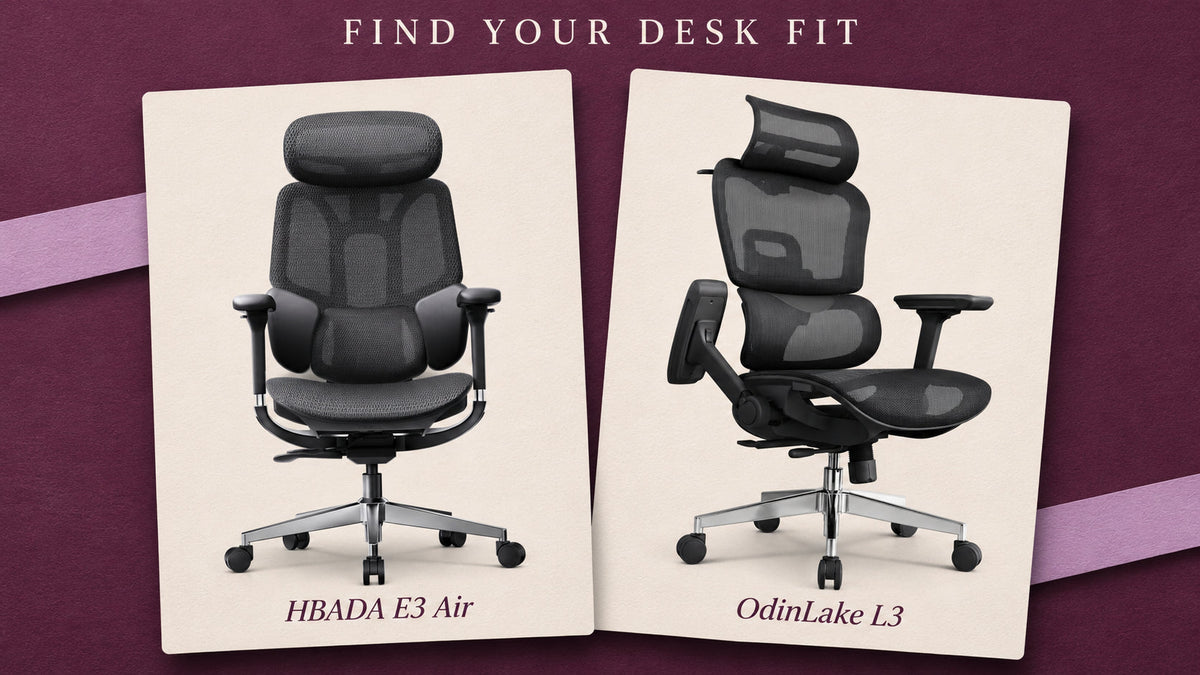
Quick answer: The E3 Air deserves a closer look if you need a shorter seat-depth setting and prefer manually adjustable lumbar support. The L3 is worth considering if its deeper seat fits your legs and flip-back armrests solve a space problem. Neither specification sheet can tell you which seat pressure you will prefer.
What exactly are we comparing?
This is a comparison of public specifications, not a hands-on test. We checked the U.S. HBADA E3 Air 2026 Edition, its official overview and dimension graphic, and the OdinLake L3 FlexBreath on November 26, 2026. Both are currently listed models. We have not verified their original launch dates or independent sales rankings.
| Buying detail | HBADA E3 Air 2026 | OdinLake L3 FlexBreath |
|---|---|---|
| Displayed price | $339 | $299 |
| Seat height | 18.3–21.7 in | 18.5–22.0 in |
| Seat depth | 16.9–18.9 in | 19.7–21.7 in |
| Seat width | 20.3 in | 20.5 in |
| Brand-recommended height | 5 ft 1 in–6 ft 5 in | 5 ft 3 in–6 ft 2 in |
| Listed weight limit | 330 lb | 350 lb |
| Support and arms | Three-zone manual lumbar; 4D armrests | Responsive lumbar; adjustable, flip-back armrests |
| Seat material | CloudMesh mesh | FlexBreath mesh |
These are manufacturer measurements, not measurements taken using one shared test protocol. Prices and availability can change. Other L3 configurations carry a preorder notice, so check your selected options rather than applying the black mesh listing to every version.
Check seat depth before choosing by height
Two people of the same height can have different thigh lengths. A broad recommended-height range therefore makes a poor substitute for checking where the front edge meets your legs.
Use a chair you already own as a reference:
- Sit back against its backrest with your feet supported.
- Measure the usable depth from the backrest contact area to the front edge.
- Check whether you can keep a small gap behind your knees without sliding forward.
- Compare that measurement with the candidate chair's shortest setting, then ask the seller how it measures seat depth.
OSHA's workstation chair guidance explains why a seat pan that is too long can press against the knees or prevent backrest support. Its guidance is general; it does not certify either chair's fit.
On paper, the E3 Air offers the shorter starting point. That makes it the more logical model to investigate if your present seat already feels too deep. The L3's range may be more useful if you need additional thigh support. This remains a shortlist decision: mesh tension, the front-edge shape, and the location of the backrest all affect the seated result.
Measure your desk opening with the chair in use
A chair that fits your body can still stop you from reaching the keyboard. Measure from the floor to the lowest obstruction under your desk, including drawers, aprons, and keyboard trays. Then check the width between the desk legs.
For typing, set the chair so your shoulders can relax and your feet remain supported. Check armrest clearance at that height—not with the chair lowered solely to make it disappear under the desk.
The L3's flip-back arms give you another way to clear an obstruction or open the sides of the seat. With the arms raised, however, they are no longer supporting your forearms. Make sure the desk arrangement still lets you work without reaching. The E3 Air emphasizes multidirectional arm adjustment; ask for its armrest height at your intended seat setting before ordering.
Choose a support approach, then test the contact
Manual adjustment can appeal to someone who wants to set lumbar contact deliberately. Responsive support can appeal to someone who changes position frequently. Those are preferences, not evidence that one approach prevents back pain.
During an authorized trial, adjust one control at a time. Type, read, and use your mouse with your usual shoes and desk arrangement. Notice whether the support stays in a useful place or makes you perch away from the backrest. Keep notes on the setting and task so you can distinguish a fit problem from an adjustment you have not explored.
Do not use a chair purchase as a treatment plan. Persistent pain, numbness, or symptoms that worsen need appropriate professional advice.
Read the warranty and return costs as separate decisions
According to HBADA's warranty policy, the base, gas lift, and casters have five-year coverage; mechanisms, armrests, and backrests have three years, subject to exclusions. OdinLake's policy gives the main polyamide frame five years and listed mechanical components two. A headline warranty number does not cover every component equally.
Both brands publish 30-day return windows with conditions. HBADA's refund policy deducts a customer-paid portion of return-label costs for preference returns without publishing a fixed amount. Packaging problems can trigger additional deductions. OdinLake's refund policy lists a $100 L3 return label and possible wear deductions up to 30%. Arranging your own return shipping still means paying your carrier. Ask for the applicable total, keep the box, and confirm any promotion-specific restrictions.
Which should you put on your shortlist?
- Investigate the E3 Air first if a shorter seat setting is your main requirement, you prefer manual lumbar adjustment, or its longer listed mechanical coverage matters to you.
- Investigate the L3 first if its depth suits you, you need flip-back arms, and the lower displayed purchase price fits your budget.
- Keep looking if neither minimum seat height works with supported feet and your keyboard, or you need a configuration or load rating outside this comparison.
Before deciding, read our chair-alone versus workspace-bundle guide to check whether the desk itself needs attention. Buy for the fit you can verify and the return cost you can accept.