A practical U.S. guide to screening a used office chair for resale, building a comparable-sale price, documenting condition, writing the listing, and planning a safer payment and pickup.
The right ergonomic setup should adapt to your body, support frequent movement, and stay comfortable through a full workday.
To sell a used office chair, first identify the exact model, check it for recalls and unsafe damage, document every working adjustment and defect, price it from recent comparable sales, and agree on payment and pickup before the buyer arrives. A clear condition record usually does more for a credible listing than a polished description.
Do not list a recalled, cracked, broken, or unstable chair. Do not promise that a chair will fit every person, relieve pain, retain its original warranty, or support a particular load unless current, model-specific documentation supports the statement. If the chair is safe to resell, give the buyer enough evidence to evaluate what it is, what works, what is worn, and what the handoff requires.
Use this resale gate before you create a listing
Begin with a decision, not a price. In the United States, the U.S. Consumer Product Safety Commission’s current reseller guidance, reviewed September 5, 2026, tells secondhand sellers to check for recalls before listing and states that recalled products cannot lawfully be offered for sale. The same safety responsibility applies whether you sell online, at a yard sale, or in person.
| What you find | Resale decision | Next action |
|---|---|---|
| A recall that applies to the exact model or production range | Do not list | Follow the recall remedy and manufacturer instructions; do not describe the chair as safe merely because it looks normal |
| Cracked base, bent structure, unstable seat or back, damaged cylinder, missing load-bearing hardware, fire or heat damage, or contamination that cannot be safely removed | Remove from sale | Stop using the chair and ask the manufacturer or an appropriate local disposal service about the next route |
| A specific serviceable part is worn, but the model and approved replacement are confirmed | Repair, document, and recheck | Follow the model-specific instructions; retain the part and service record; test only normal functions after the chair is stable |
| Chair is complete and stable; normal controls work; only disclosed cosmetic wear is present | Ready to list | Create a model, condition, photo, price, and handoff record |
This is a screening process, not a certification. Do not open, drill, heat, strike, or improvise a repair to a gas cylinder. If you cannot tell whether a part is structural or whether a remedy applies, pause the sale and contact the manufacturer with the model and label information.
Identify exactly which office chair you are selling
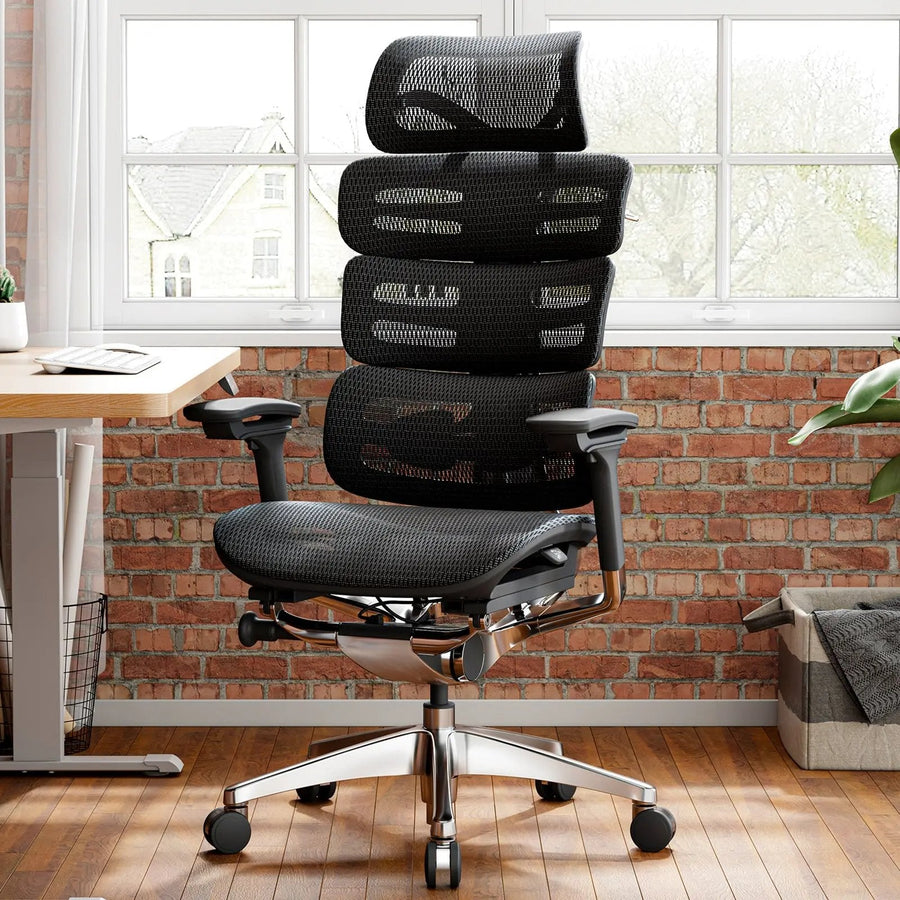
Start with the label under the seat, the manual, the order record, and the manufacturer’s current product page. Record the brand, model, color, upholstery or mesh option, headrest or footrest configuration, armrest type, and any included accessories. A product family name is not enough when several configurations look similar.
Use the exact model information to search the CPSC recall database at cpsc.gov/recalls. Match the model, identifying numbers, dates, and photographs in the notice; a similar-looking chair is not proof of a match or a non-match. Keep a dated note of what you checked. If a recall notice might apply, ask the manufacturer before offering the chair.
Copy features only from records that belong to the chair you own. Do not infer upholstery material, weight capacity, component compatibility, certification, or warranty coverage from appearance. A warranty may be limited to the original purchaser or require an order record, so say “original receipt available” or “transferability not confirmed” instead of promising coverage.
Protect personal information while preserving evidence. Keep a full photo of the product label in your private file, but crop or obscure an address, order number, registration code, or full serial number in a public listing when it is not necessary. You can give a serious buyer the specific identifiers needed for a recall or compatibility check without posting unrelated account data.
Create a condition record a buyer can verify
Inspect the unloaded chair in good light on a flat floor. Look around the base, casters, center column, seat support, back attachment, arm attachments, and visible fasteners. Do not use the chair if you see a structural crack, deformation, an insecure joint, or unexpected movement. If the chair is stable, operate each normal adjustment through its intended range without forcing it.
| Record | What to check | What to show or say |
|---|---|---|
| Structure | Base, column, seat support, back connection, arm mounts, visible hardware | “Stable on a flat floor; no visible cracks found” only if that is what you actually observed |
| Movement | Casters roll and swivel normally; chair rotates without binding | Disclose a sticking caster, wheel wear, noise, or floor-specific limitation |
| Controls | Seat height, tilt, recline, lock, arm, headrest, and other controls that the model actually includes | List every tested function separately; do not write “everything works” if you skipped a control |
| Contact surfaces | Mesh, fabric, foam, seams, edges, arm pads, headrest | Photograph stains, fraying, compression, scratches, fading, or repaired areas at useful scale |
| History | Purchase date, use environment, repair or replacement parts, smoke or pet exposure when known | Use factual, limited statements; write “unknown” when a history point cannot be confirmed |
Take a front, rear, left, right, and three-quarter view. Add close-ups of the model label, controls, base and all five casters, upholstery, accessories, and every defect. A short video can show the height, swivel, tilt, or recline operating normally, but it does not replace written disclosures. Keep the unedited originals until the transaction is finished.
Include dimensions a buyer needs for fit, transport, and door clearance. Use OdinLake’s office-chair measurement guide for the detailed method. State whether each dimension was measured by you or copied from a current specification, and do not merge figures from different configurations.
The header image prepared for this article illustrates the documentation task: a seller photographs a complete generic chair with a tape measure and blank condition card nearby. It is not an OdinLake product, a condition certification, or proof of a chair’s resale value.
Price the chair from comparable sales, not a universal percentage
There is no defensible rule that every used office chair should sell for a fixed percentage of its original price. Age, exact configuration, verified condition, local demand, missing parts, delivery effort, platform fees, and the time you are willing to wait all affect the transaction.
Build a small comparable-sale record. Look for completed or sold listings where a channel exposes them; asking prices show what sellers requested, not what buyers paid. Try to collect five to ten reasonably close observations, but do not pad the set with unrelated chairs just to reach a number.
- Match the identity. Prefer the exact model and configuration. Separate chairs with different headrests, arms, upholstery, or generations.
- Match the condition. A clean, fully functional chair is not comparable to one with a sinking lift, damaged mesh, or missing hardware.
- Match the market. Local-pickup prices reflect a different buyer pool and cost structure from packed, shipped transactions.
- Match the date. Recent observations usually describe current demand better than an old sale.
- Record the outcome. Mark each figure as sold, asking, discounted, bundled, or unknown.
| Comparable field | Your record | Why it matters |
|---|---|---|
| Model and configuration | Exact match, near match, or unsuitable | Prevents a premium or stripped-down version from setting the wrong anchor |
| Condition and included parts | Working functions, defects, accessories, documents | Shows what the buyer actually received |
| Location and channel | Local pickup, consignment, dealer, or shipped | Captures fees, reach, handling, and delivery differences |
| Date and price type | Date observed; sold or asking; fees known or unknown | Keeps an old or uncompleted listing from looking like current sale evidence |
Use the strongest matches to set a range, then choose an asking price that reflects your time goal and likely negotiation. A current new-product price can provide context, but it is not a resale formula. If good sold comparisons do not exist, say that the market evidence is limited and use a wider range. False precision is less useful than a transparent estimate.
Choose the sales channel based on the chair and the work
| Channel type | Best fit | Tradeoff to confirm |
|---|---|---|
| Local marketplace or community classifieds | One complete chair that is practical to inspect and collect locally | You manage messages, screening, payment, location, and pickup timing |
| Consignment shop or used-office-furniture dealer | A recognized, functional model when you prefer less direct selling work | Acceptance rules, commission, payout timing, transport, and the net amount |
| Office liquidator | Several matching chairs or a larger workplace removal | Quantity, model list, condition grading, site access, labor, and pickup deductions |
| National marketplace with shipping | A chair whose value and demand justify professional packing and freight risk | Disassembly rules, packaging, carrier limits, damage claims, returns, fees, and seller protection |
For many ordinary chairs, local pickup avoids the cost and damage risk of parcel shipping. Do not offer shipping until you know the manufacturer-approved disassembly method, packed dimensions, package weight, materials, carrier service, insurance terms, fees, and return exposure. Never pull apart a pressurized cylinder to make the box smaller unless model-specific instructions and qualified service support that work.
Write a listing that separates evidence from sales language
Lead with identity, condition, and logistics. Avoid vague superlatives such as “perfect ergonomic chair” or “like new” when photographs show wear. “Ergonomic” describes a design intent or product category; it does not prove that the chair will fit a specific buyer or treat a health condition.
Copy-ready listing template
Title: Used [brand] [exact model/configuration] office chair — [one verified differentiator]
Identity: Purchased [month/year or unknown]. Color/configuration: [details]. Included: [headrest, arms, manual, accessories]. Original receipt: [available/not available]. Warranty transfer: [confirmed with source/not confirmed].
Function check on [date]: Seat height [works/not working/not tested]; swivel [status]; tilt or recline [status]; locks [status]; arms [status]; headrest or footrest [status]; casters [status].
Condition: [Specific wear, stain, scratch, noise, repair, replacement part, or missing item]. Photographs [numbers] show the disclosed areas. Smoke, pet, and use history: [known facts or unknown].
Measurements: Overall width [ ]; seat height range [ ]; largest transport dimension [ ]. Measurements are [seller measured/manufacturer published] for [configuration].
Sale terms: Price [ ]; payment through [agreed method/platform]; pickup area [general area]; stairs or access constraints [ ]; loading responsibility [ ]; inspection window [ ].
Keep the title compact and put qualification in the body. A buyer should not need to infer whether the chair pictured is the exact item, whether a control was tested, or whether pickup involves stairs.
Set payment and pickup rules before the buyer arrives
The Federal Trade Commission’s guidance for people selling items online warns about fake payment notifications, bogus refund requests, check-overpayment schemes, and requests for account verification codes. Verify payment in your actual account or the platform’s official interface; do not rely on an email, screenshot, or message supplied by the buyer.
- Keep communication and payment inside the sales channel when that is required for seller protection.
- Do not accept an overpayment and send the difference to the buyer, mover, or another person.
- Do not share a security or verification code sent to your phone or email.
- Do not pay an unexpected fee through a link in a buyer’s message to “upgrade” or “release” funds.
- For a nonlocal transaction, read the platform’s current seller-protection, tracking, delivery, return, and dispute terms before accepting it.
For local pickup, agree on a time window, general location, payment method, inspection process, and who will load the chair. Choose a well-lit, permitted handoff area when possible. Keep private areas and unrelated belongings out of the meeting space. Tell the buyer about doors, stairs, elevators, parking, and the chair’s largest dimension before arrival.
Clear the route, protect the floor, and keep children and pets away from the loading zone. Do not promise to lift or load an object you cannot control. If the chair must be disassembled, use the model’s instructions and prepare it before the meeting rather than improvising under time pressure.
Finish with a simple handoff record
A brief record can prevent later confusion. Include the date, seller and buyer names or platform identifiers, item, exact model, only the last few characters of the serial number where appropriate, agreed price, payment method, included parts, condition disclosures, and who took possession. Both people can retain a copy or an in-platform message that confirms the same facts.
This record is not a substitute for applicable law, platform policy, or a required commercial receipt. Writing “as is” does not erase recall obligations, misrepresentation rules, or other duties that may apply. If you sell regularly, sell on behalf of a business, or are unsure about tax, licensing, warranty, or consumer-law obligations, use current guidance for your state and platform or ask a qualified professional.
If the chair is not sellable
Do not recast a structural defect as “cosmetic,” and do not use “for parts” to move a recalled or hazardous chair to another person. A non-sellable chair may still have a manufacturer remedy, an approved repair route, a responsible donation option after repair, material recovery, or local disposal requirements. OdinLake’s office-chair disposal guide covers that separate route decision.
If you own an OdinLake chair and cannot confirm its model, part, current documentation, or support route, send clear label and condition information through OdinLake customer support before making a claim in the listing.
A successful sale is not simply the highest asking price. It is a transaction in which the chair was eligible to sell, the listing matched the actual item, the buyer could verify the important facts, the payment was real, and the handoff was planned.
Frequently Asked Questions
Where is the best place to sell a used office chair?
The best channel depends on the chair’s value, local demand, quantity, and your willingness to manage pickup or shipping. Local marketplaces often suit one bulky chair; dealers or consignment may reduce your work but also reduce the net payment; liquidators fit larger matching quantities. Compare acceptance rules, fees, payout timing, transport, and protection before choosing.
How much should I sell my used office chair for?
Use recent sold or completed listings for the exact model, configuration, condition, location, and channel when available. Record asking prices separately because they do not prove a sale. Adjust your range for defects, missing parts, fees, transport, and how quickly you want to sell; avoid a universal percentage of the original price.
What photos should I include in an office-chair listing?
Include front, rear, side, and three-quarter views plus the model label, controls, base, all five casters, upholstery, accessories, and close-ups of every defect. Protect personal identifiers in public photos. Use natural light, avoid filters that hide wear, and keep the original files until the transaction is complete.
Can I sell an office chair with a broken gas lift?
Do not list it as a normal working chair. Stop using it, identify the exact model, and ask the manufacturer whether an approved repair and part are available. Do not open, drill, heat, strike, or improvise work on the pressurized cylinder. If the chair cannot be restored and rechecked through an appropriate route, remove it from sale.
Can I sell a recalled office chair?
No. CPSC states that it is unlawful to offer a recalled product for sale in the United States. Match the chair to the recall’s model and production information, follow the listed remedy, and contact the manufacturer or CPSC when applicability is unclear.
Should I ship a used office chair or require local pickup?
Local pickup is often simpler for a bulky chair. Offer shipping only after confirming an approved disassembly method, packed size and weight, packaging, carrier service, insurance, fees, seller protection, damage procedure, and return terms. Do not improvise removal of a gas cylinder merely to fit a box.
How do I avoid scams when selling an office chair online?
Verify payment in your real account or the platform’s official interface. Do not trust a payment screenshot or unexpected email, accept an overpayment and refund the difference, pay a surprise fee through a buyer’s link, or share a verification code. Keep the transaction inside the platform when its protection rules require it.
Before publishing, read the listing once as a buyer: Can you identify the exact chair, see its defects, understand what was tested, reproduce the price logic, and plan the pickup? If any answer is no, add the missing evidence rather than stronger sales language.