A material-aware method for finding an office-chair odor, cleaning only the affected zone, drying every layer, and deciding when professional help is safer.
The right ergonomic setup should adapt to your body, support frequent movement, and stay comfortable through a full workday.
To get a smell out of an office chair without damaging it, first locate the strongest-smelling area and identify the upholstery care code. Vacuum dry debris, use only a cleaner allowed for that material, keep moisture away from the mechanism and controls, and let every layer dry completely. Then leave the room for a few minutes and recheck the chair with a reset sense of smell.
That sequence matters because an odor can come from surface residue, a spill that reached the foam, trapped moisture, smoke, a cleaning product, or even the room around the chair. Spraying fragrance over the whole chair may hide the signal temporarily while leaving the source—and possibly extra residue—behind.
- Find the strongest-smelling zone and rule out nearby room sources.
- Check the upholstery code and the chair maker's care instructions.
- Vacuum dry debris, then treat only the source with an approved method.
- Dry the surface, seams, underside, and any absorbent layer completely.
- Leave the room, return with a reset sense of smell, and decide whether the chair is ready or needs professional help.
Find the odor before choosing a cleaner

Do not start by soaking the seat. Move the chair away from the desk, empty any pockets or removable accessories, and compare the seat, back, headrest, arm pads, underside, casters, and the floor beneath it. Check removable covers separately. A nearby wastebasket, damp rug, pet bed, or HVAC vent can make the chair seem responsible when it is not.
Use the odor pattern as a clue, not a diagnosis:
| What you notice | Where to inspect | Best first move |
|---|---|---|
| Stale body or food odor that is strongest at contact areas | Seat surface, front edge, backrest, headrest, and arm pads | Vacuum, then spot-clean only with an approved upholstery method |
| A sour odor concentrated in one spot | Seams, the underside of the seat, and any removable cushion or cover | Look for an old spill and determine whether it reached absorbent padding |
| A musty smell that returns after the chair dries | Foam, hidden fabric, chair underside, nearby wall, rug, and room humidity source | Stop adding moisture and find the damp source before further cleaning |
| Smoke, perfume, or room-wide odor | All fabric surfaces and the surrounding room | Ventilate and remove the environmental source before judging the chair |
| A sharp “new product” or chemical smell | The chair as a whole, packaging, and any recently applied product | Move it to fresh air, stop adding cleaners, and consult the seller or manufacturer if it persists or irritates you |
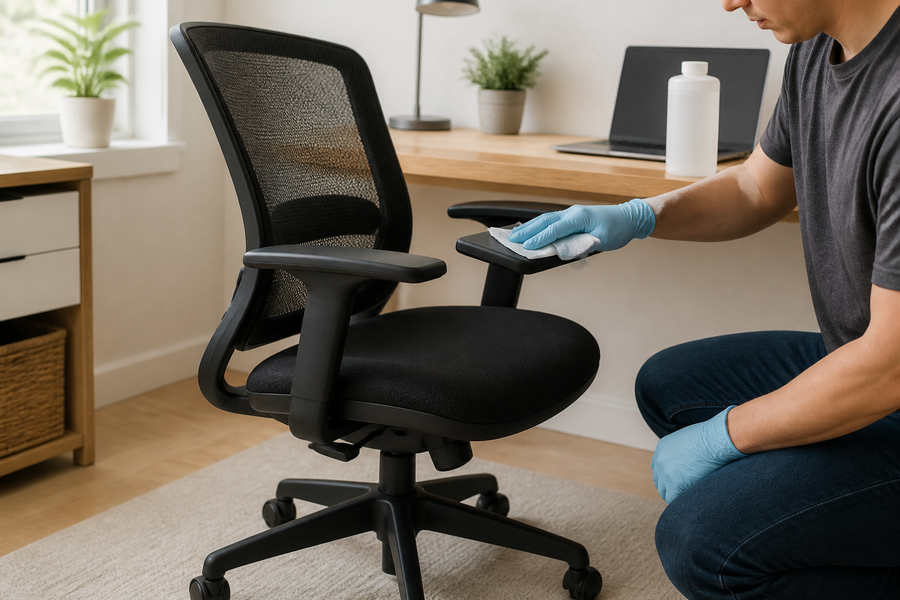
The close-up image supplied with this article shows why this inspection should be zone by zone: the seat mesh, back mesh, arm pad, frame, and control area are different surfaces. The place that holds the odor may not be the place that can safely accept liquid.
Let the cleaning code set the boundary
Look for a care label under the seat, inside a removable cover, or in the chair maker’s care guide. The upholstery industry’s W, S, WS, and X codes, documented in ACT’s Cleaning Resources & Considerations guidance, are a useful boundary: W permits an appropriate water-based upholstery cleaner; S calls for a water-free solvent; WS allows either category; and X means vacuuming or light brushing only. The guidance also calls for pretesting and warns against overwetting or saturating upholstery.
| Code | What it allows | What it does not authorize |
|---|---|---|
| W | A suitable water-based upholstery cleaner, after a hidden test | Soaking the fabric, foam, seams, or mechanism |
| S | A suitable water-free solvent used as directed | Water, improvised mixtures, or saturation |
| WS | Either an approved water-based cleaner or mild cleaning solvent | Mixing products or treating the code as permission to use anything |
| X | Vacuuming or light brushing | Any liquid cleaner; persistent odor may require professional help |
A code describes a cleaning category, not a universal recipe. It does not automatically approve vinegar, baking soda, steam, a carpet extractor, disinfectant, or a scented spray. If the chair maker gives narrower instructions, follow those. For leather, coated leather, faux leather, rubber-like arm pads, and plastic trim, use the maker’s material-specific care directions rather than an upholstery-code shortcut.
If your real task is a full cushion cleaning rather than odor removal, use OdinLake’s chair-cushion cleaning guide. It covers common cushion constructions and cleaning codes in more depth.
How to remove the smell without soaking the chair
1. Move the chair into fresh air and clear the work area
Work in a well-ventilated area protected from direct rain and harsh sun. Remove loose accessories only if the chair’s instructions say they are removable. Keep power cords unplugged on an electric chair, and keep all liquids away from switches, charging ports, motors, cables, the tilt assembly, gas lift, and caster bearings.
Take a quick photo before disassembly and do not open sealed mechanisms or unzip fixed upholstery just to chase a smell. The goal is controlled surface care, not an improvised repair.
2. Vacuum the dry chair and isolate the strongest zone
Use a clean upholstery attachment at low suction if the material permits. Work across the seat, back, seams, creases, and underside without snagging mesh or pulling on loose threads. A soft brush can help lift dry particles from textured fabric, but stop if it abrades the surface.
Vacuuming first removes dust and crumbs that can hold odor or turn into paste when wet. It also gives you a cleaner baseline: after vacuuming, smell each zone again and treat only the area that still needs attention.
3. Treat only the source with an approved method
Test the chosen product on a hidden area and let that test dry before judging color, texture, stiffness, or finish. Apply cleaner to a white cloth rather than pouring or spraying it directly onto the chair. Blot from the outside of a localized spot toward the center, changing to a clean section of cloth as residue transfers.
- W or WS fabric: Use a small amount of a chair-approved water-based upholstery cleaner. Blot; do not scrub foam or flood seams.
- S fabric: Use only the specified water-free solvent with the ventilation and handling precautions on its label. Do not substitute a water mixture.
- X fabric: Stay dry. Vacuum or lightly brush, then contact a qualified upholstery cleaner if the odor remains.
- Mesh: Support the mesh rather than pressing hard against it. Use the maker-approved method and minimal moisture; a full mesh-chair cleaning is a separate task from treating one odor source.
- Leather or faux leather: Wipe only with a product and method approved for the exact surface. Do not assume a household acid, alkaline powder, alcohol, or fabric cleaner is safe for its finish.
- Hard arm pads and trim: Wipe a cloth-dampened surface only when the care guide permits it, then dry it. Do not let liquid run into button gaps or joints.
If the odor came from a known spill, clean the spill according to both the chair and product instructions. Do not combine cleaners in pursuit of a stronger result. The EPA advises users to follow labels, ventilate, and never mix household care products unless the label directs it.
4. Remove residue and dry every layer
Follow the cleaner’s instructions for residue removal. If the approved process calls for a water-dampened rinse cloth, wring it thoroughly and use it only on a W or WS surface. An S or X surface should not receive that water step.
Press clean, dry towels against damp upholstery; do not twist, crush, or sit on it. Let the chair dry with air moving around both the top and underside. A fan can circulate room air, but avoid concentrated heat from a hair dryer, heater, or direct midday sun unless the manufacturer specifically allows it. Heat may change foam, adhesives, coatings, leather finishes, or tensioned materials.
There is no honest universal drying time. Thickness, humidity, airflow, the amount of liquid, and what lies beneath the surface all matter. The chair is ready for the next check only when it feels dry at the surface and seams, the underside is dry, no cool damp zone remains, and the controls and moving parts are dry and unobstructed.
5. Leave the room, return, and recheck
Continuous exposure makes it easy to stop noticing an odor. Once the chair is fully dry, leave the room for several minutes, return, and compare the chair with the surrounding air. Check the original problem zone first, then the underside and floor.
A successful result is not “the fragrance is stronger.” It is that the original odor is absent or clearly reduced after drying and does not return through normal use. If it returns quickly, assume the source remains deeper in the chair or in the room rather than repeating a wetter version of the same treatment.
Match the stop point to the kind of odor
Everyday contact, food, or drink odor
One careful, code-compatible surface treatment may be enough when the source is recent and localized. If the liquid reached foam or a fixed cushion core, surface improvement does not prove the interior is clean or dry. Ask the manufacturer whether the cushion is replaceable or suitable for professional extraction.
Musty odor or visible mold
Do not keep wet-cleaning a musty chair until you have found the moisture source. The EPA’s mold guidance for porous materials and upholstered furniture emphasizes complete drying, explains that porous materials may be difficult or impossible to clean fully, and notes that professional restoration may be appropriate for valuable furniture.
Visible growth, a chair that stayed wet, an odor that returns with humidity, or contaminated absorbent foam is a stop signal. Isolate the item from normal use and seek qualified guidance rather than brushing, spraying, or sitting on it. Replacement may be more reliable than repeated surface treatment.
Smoke, perfume, or another room-wide odor
Ventilate and remove the environmental source first. Fabric may adsorb odors from the room, so cleaning only the chair while the source remains can produce a short-lived result. If the chair’s code is X or the odor is deeply embedded, a professional upholstery cleaner can judge whether treatment is appropriate.
New-chair or chemical odor
Remove packaging and ventilate in accordance with the product instructions. Do not add ozone, fragrance, solvent, or an improvised neutralizer. The EPA’s guidance on volatile organic compounds and indoor air recommends source control, ventilation, and following manufacturer directions for household products.
A smell alone cannot identify a specific chemical or risk level. If a sharp odor persists, worsens, or causes irritation, stop using the chair, move away from the exposure, and contact the seller or manufacturer with the model, purchase date, lot information if available, and a description of when the odor is strongest.
Avoid fixes that can create a second problem
- Do not saturate the seat. Liquid can carry residue into foam, extend drying time, affect adhesives, and reach hardware below.
- Do not mix cleaners. Use one compatible product exactly as labeled, with ventilation.
- Do not mask the result with perfume. A new scent makes the source harder to evaluate and may bother the next user.
- Do not steam or heat-dry by default. Heat and moisture can affect finishes, foam, glue, and tensioned mesh.
- Do not scrub mesh or coated surfaces aggressively. Friction can change texture or damage a protective finish.
- Do not spray controls or mechanisms. Clean exterior surfaces with a controlled cloth only when the care guide permits it.
- Do not repeat a failed method with more product. A returning odor is evidence to reassess the source, not permission to soak the chair.
When cleaning is no longer the right next step
Stop home treatment when there is visible mold, unknown contamination, damaged upholstery, wet or foul-smelling internal foam, an X-code surface that still smells, an odor linked to an electrical component, or no reliable care information. Also stop when the chair remains damp or the odor returns after a complete dry-and-recheck cycle.
For an OdinLake chair, use the model label, photos, care-code information, and a short history of the spill or odor when you contact OdinLake support. That gives the support team a better basis for confirming care instructions, replacement-part options, or the need for professional service.
Frequently Asked Questions
Why does my office chair smell?
Common sources include body oils, food residue, a spill in the cushion, damp foam, smoke, fragrance, cleaning-product residue, or odor from the surrounding room. Compare the seat, seams, underside, arm pads, casters, and nearby floor before choosing a treatment. A musty odor that returns after drying calls for moisture-source investigation, not more fragrance.
Can you use baking soda on an office chair?
Not as a universal default. A dry fabric surface may tolerate it only when the chair maker’s care instructions permit the method, but powder can remain in mesh, seams, foam, and mechanisms. Never use it as a substitute for the chair’s cleaning code, and avoid it on leather, coated surfaces, or any material whose care guidance is unclear.
How do you get sweat smell out of a mesh office chair?
Vacuum the dry mesh, locate the strongest zone, and use a small amount of the cleaner approved for that chair’s mesh and frame. Support the mesh, avoid hard scrubbing, keep liquid away from controls, and let the seat and back dry from both sides before use. If odor returns, check the surrounding room and any foam, headrest, or fabric panel rather than repeatedly wetting the mesh.
How do you get a musty smell out of a chair cushion?
First find and stop the moisture source, then determine whether the cushion is removable and what its care code allows. A fully dry surface does not guarantee that internal foam is dry. Visible mold, persistent mustiness, or odor that returns with humidity warrants professional assessment or replacement rather than repeated wet cleaning.
Can you use vinegar on an office chair?
Only if the chair manufacturer explicitly allows it for that exact material. Vinegar is not authorized merely because a label says W or WS, and it can affect dyes, coatings, leather finishes, metal, or adhesive-backed layers. A manufacturer-approved upholstery product and a hidden test are safer than an improvised mixture.
How long should an office chair dry before you sit on it?
Use condition, not a fixed number of hours. The surface, seams, underside, and any removable layer must be fully dry, with no cool damp spot or trapped moisture, before use. Humidity, airflow, upholstery thickness, and the amount of cleaner can change the drying time substantially.
The best next step is the smallest one that fits the evidence: identify the source, obey the care boundary, treat only the affected zone, dry completely, and recheck. If the odor survives that cycle, preserving the chair means stopping—not escalating to a stronger, wetter, or more improvised treatment.