A surface-by-surface method for deciding when disinfection is needed, matching the label to the chair material, completing contact time, and avoiding damage.
The right ergonomic setup should adapt to your body, support frequent movement, and stay comfortable through a full workday.
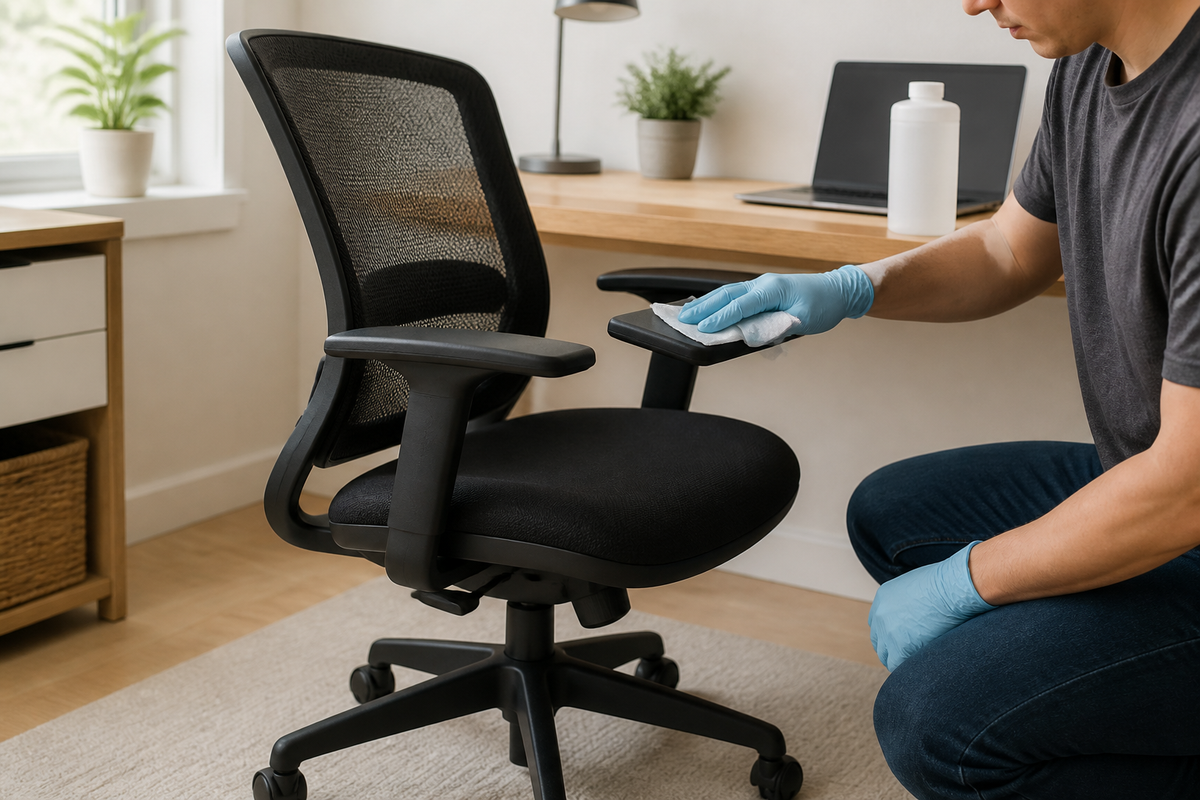
To disinfect an office chair without damaging it, identify every surface first, read the chair maker’s care instructions, and then read the disinfectant’s Directions for Use. Clean away visible soil before disinfecting. Treat a surface only when the product label covers that surface type and use site, keep it visibly wet for the full label contact time, and let it dry before the chair returns to service.
That does not mean spraying the whole chair. A product labeled for hard, nonporous surfaces may be suitable for an allowed plastic arm pad yet make no disinfection claim for mesh, fabric, foam, leather, painted metal, or electronics. If the two sets of instructions do not clearly overlap, stop at manufacturer-approved cleaning or ask the chair maker for a compatible method.
First Decide Whether the Chair Needs Disinfection
Cleaning, sanitizing, and disinfecting are different jobs. Cleaning removes dirt, impurities, and many germs. Sanitizing reduces germs to a level defined as safe by public-health codes or regulations. Disinfecting uses chemicals to kill most remaining germs on a surface. The terms on a bottle are not interchangeable, and a cleaner is not automatically a disinfectant.
The CDC’s current household guidance says regular cleaning is enough in most situations and that disinfection is more relevant when someone is sick or a person at higher risk is present. In an office, a shared chair may also be included in a documented workplace infection-control procedure. The practical question is therefore not “How often can I disinfect this chair?” but “What contamination event am I responding to, and what method is authorized for each surface?”
| Situation | Proportionate response |
|---|---|
| Routine dust, crumbs, skin oil, or a normal single-user workday | Use the chair maker’s regular cleaning method. Disinfection may not be necessary. |
| A shared chair after an illness concern or an organization-required protocol | Clean first, then disinfect only the eligible surfaces with a correctly labeled product. |
| An unknown secondhand chair with no care label | Identify the materials and request instructions before using a chemical treatment. Do not assume one product fits the whole chair. |
| Visible blood, vomit, feces, needles, pests, mold growth, or contamination inside the cushion | Isolate the chair and use the employer’s exposure-control procedure or a qualified remediation service. This is not a routine wipe-down. |
Build a Surface-Eligibility Map Before Opening the Product
Walk around the chair with its manual or care page and make a quick map. Record the upholstery, arm-pad material, frame finish, painted or plated parts, adjustment controls, exposed seams, and any powered accessory. Then compare those terms with the disinfectant label—not the front-label marketing phrase alone.
The EPA explains that the Directions for Use identifies where and how a registered disinfectant can be used and gives its contact time. The EPA registration number uniquely identifies the product even when equivalent formulations are sold under different brand names. For a U.S. workplace, confirm the registration number and the label directions for the intended surface, use site, and target organism. Outside the United States, use the corresponding national regulator and the local product label.
| Chair area | Eligibility question | Default when the answer is unclear |
|---|---|---|
| Hard plastic arm pads, frame covers, or an approved hard handle | Do both the chair care instructions and disinfectant label allow this material and use site? | Clean with the maker-approved method; do not claim disinfection. |
| Painted, coated, plated, or polished metal | Will the treatment preserve the finish, and does the label name the applicable surface? | Avoid unapproved chemicals and contact the chair maker. |
| Mesh, woven fabric, or a fabric-covered cushion | Does the product label specifically authorize disinfection—not merely deodorizing or sanitizing—on that soft surface and use site? | Use the approved cleaning method only, or arrange professional treatment. |
| Leather or coated synthetic upholstery | Does the upholstery specification permit the exact product and aftercare? | Do not infer compatibility from a generic “hard surface” claim. |
| Adjustment buttons, cable ports, powered controls, seams, and mechanism gaps | Can the surface be treated without liquid entering the component, and do the equipment instructions permit it? | Do not spray or flood; follow the equipment maker’s cleaning route. |
| Casters, axles, cylinder, and under-seat mechanism | Is disinfection actually required, and can it be done without washing lubricant or debris into moving parts? | Keep liquids out of the mechanism. Use the separate office-chair wheel cleaning procedure for hair and grit. |
Soft upholstery deserves special caution. Most EPA-registered liquid antimicrobial products have historically been registered for hard, nonporous surfaces. The EPA now has separate efficacy guidance for certain soft-surface textile disinfection claims in nonresidential settings. That distinction matters: a hard-surface claim does not transfer automatically to an office-chair seat, and a soft-surface sanitizing claim is not the same as a disinfecting claim.
Use a Label-First Disinfection Sequence
Once the exact surface and product are confirmed, use this controlled sequence. The chair manual, workplace procedure, and disinfectant label take priority wherever they are more specific.
- Take the chair out of service. Move it away from the active workstation and prevent anyone from sitting down mid-process. If the chair or an attached accessory has power, disconnect it as its instructions require.
- Ventilate and prepare protective equipment. Open the room or use ventilation as directed. Wear the gloves, eye protection, or other equipment named on the product label. Keep children, pets, food, and drinks away.
- Read the entire Directions for Use. Confirm the EPA registration number, intended use site, surface type, target pathogen when relevant, dilution or ready-to-use status, application method, contact time, rinsing or wiping instructions, ventilation requirements, and disposal directions.
- Clean first. Remove crumbs and loose debris, then clean visible soil with the chair-approved method. Soil can interfere with the disinfectant reaching the surface. For a full material-by-material cleaning process, use OdinLake’s office-chair cleaning guide.
- Let the cleaning step reach the required state. Remove residue or dry the surface if the disinfectant label or chair instructions require it. Never mix the cleaner and disinfectant in the same container or layer products contrary to their labels.
- Test material compatibility where permitted. On an inconspicuous but representative area, follow the actual concentration, application, contact time, and aftercare. Check only after the test area has dried. A brief dab that is wiped off immediately does not test the full procedure.
- Apply without flooding the chair. Use the label-approved method. Near seams, controls, or mechanisms, a premoistened wipe or product applied to a cloth may offer better control only if the label allows that application. Do not reinterpret a spray-only or immersion direction.
- Start timing when coverage is complete. Keep the treated surface visibly wet for the exact label contact time. The EPA notes that reapplication may be needed when a surface dries too early. Do not shorten the time because the surface “looks clean.”
- Perform only the stated aftercare. Some labels require wiping, rinsing, or a clean-water step; others direct the user to allow air drying. “Always rinse” and “never rinse” are both unreliable universal rules.
- Dry, inspect, and release the chair. Keep it out of service until the treated surfaces are dry and any required ventilation period is complete. Wash your hands after removing gloves and store the product as its label directs.
Keep Liquid Away From Controls and Mechanisms
An office chair is not one washable object. Armrests may telescope, seat-depth rails move under load, tilt controls connect to cables, and powered seating or accessories can contain switches and connectors. Liquid that disappears into a seam has not necessarily dried just because the visible surface has.
Do not spray toward an adjustment button, cable exit, cylinder, caster axle, spring, bearing, or under-seat housing. Do not turn the chair upside down while a treated surface is still wet; that can redirect liquid into components. If product enters a control or electrical area, stop using the chair, disconnect power when that can be done safely, and follow the manufacturer’s support instructions. Do not test a powered feature merely to see whether it still works while moisture may be present.
Know When the Treatment Has Passed
A successful disinfection process is defined by following validated label directions on an eligible surface—not by a strong odor, visible foam, or a glossy wet finish. Before the chair returns to use, confirm all of the following:
- the exact treated surface was covered by both the chair care instructions and the disinfectant directions;
- visible soil was removed before disinfection;
- the surface stayed visibly wet for the full contact time;
- required rinsing, wiping, air drying, ventilation, and disposal steps were completed;
- the chair is dry, stable, and free of chemical residue where skin or clothing contacts it;
- there is no dye transfer, whitening, tackiness, swelling, cracking, fraying, delamination, loss of gloss, persistent odor, or finish change;
- controls move normally only after the chair is dry, with no liquid visible around gaps or powered parts.
The EPA’s soft-textile guidance specifically treats observations such as fraying, cracking, delamination, and dye bleaching as signs of possible incompatibility during product testing. If any change appears on your chair, stop repeated treatment and document the product, lot, dilution, contact time, material, and damage for the chair manufacturer or workplace safety contact.
When a Chair Surface Does Not Support Disinfection
If a mesh back, fabric seat, foam cushion, leather finish, or unknown coating is not covered by an appropriate product label and the chair’s care instructions, do not improvise with alcohol, bleach, vinegar, essential oils, steam, or a homemade mixture. A chemical can clean or discolor a surface without delivering a supported disinfection result.
Instead, choose the safest available route:
- use manufacturer-approved cleaning when routine cleaning is proportionate to the situation;
- remove and launder a cover only if it is designed for removal and the care label provides the method;
- ask the chair or upholstery manufacturer for a compatible registered product and documented procedure;
- use a qualified upholstery or remediation service when contamination extends into porous padding or requires occupational controls;
- replace a component or retire the chair when contamination cannot be treated without unacceptable material or exposure risk.
A secondhand chair is not automatically unsafe, but uncertainty changes the workflow. Obtain the model and upholstery information, photograph labels before they fade, inspect seams and padding for pests, mold, odor, moisture, or biological contamination, and decide whether the chair can be cleaned and treated without hiding a deeper problem. A cosmetic wipe-down is not evidence that internal foam or inaccessible cavities have been disinfected.
Frequently Asked Questions
Can I use disinfecting wipes on an office chair?
Only on a surface named or clearly covered by the wipe’s Directions for Use and allowed by the chair maker. Confirm the use site, surface type, contact time, and aftercare. One wipe may not keep a large armrest or frame visibly wet for the full contact time, so follow the label’s coverage and reapplication directions.
How do I disinfect a fabric or mesh office chair?
Do not assume a hard-surface disinfectant works on fabric or mesh. Look for an EPA-registered product whose label specifically includes the relevant soft surface, use site, and disinfection claim, then confirm compatibility with the chair maker. If either approval is missing, clean by the manufacturer-approved method or use a qualified professional.
Can I spray disinfectant directly on the chair?
Use only the application method on the product label and keep liquid out of seams, adjustment controls, electrical parts, the cylinder, and caster mechanisms. If the label permits application to a cloth or supplies a premoistened wipe, that may provide better control near gaps. Never change a label-specified application method on your own.
Do I need to clean an office chair before disinfecting it?
Yes. The CDC advises cleaning before disinfecting because dirt and other impurities can make it harder for disinfecting chemicals to reach and kill germs. Use a cleaner compatible with the chair surface, and follow any transition or drying step required before applying the disinfectant.
How long should disinfectant stay wet on a chair?
For the exact contact time printed in the product’s Directions for Use for that surface and target. There is no universal number. The surface must remain visibly wet for that entire period, and the label may require reapplication if it dries too soon.
How should I disinfect a secondhand office chair?
Identify the model and materials, inspect for contamination or damage, clean each surface by its approved method, and disinfect only eligible surfaces with a correctly labeled product. Stop and seek professional help for pests, mold, visible body fluids, unknown soaked padding, damaged upholstery, or a chair whose care instructions cannot be established.