Quick answer
The right ergonomic setup should adapt to your body, support frequent movement, and stay comfortable through a full workday.
Spend ten minutes on Kickstarter and you'll notice it: chairs are everywhere.
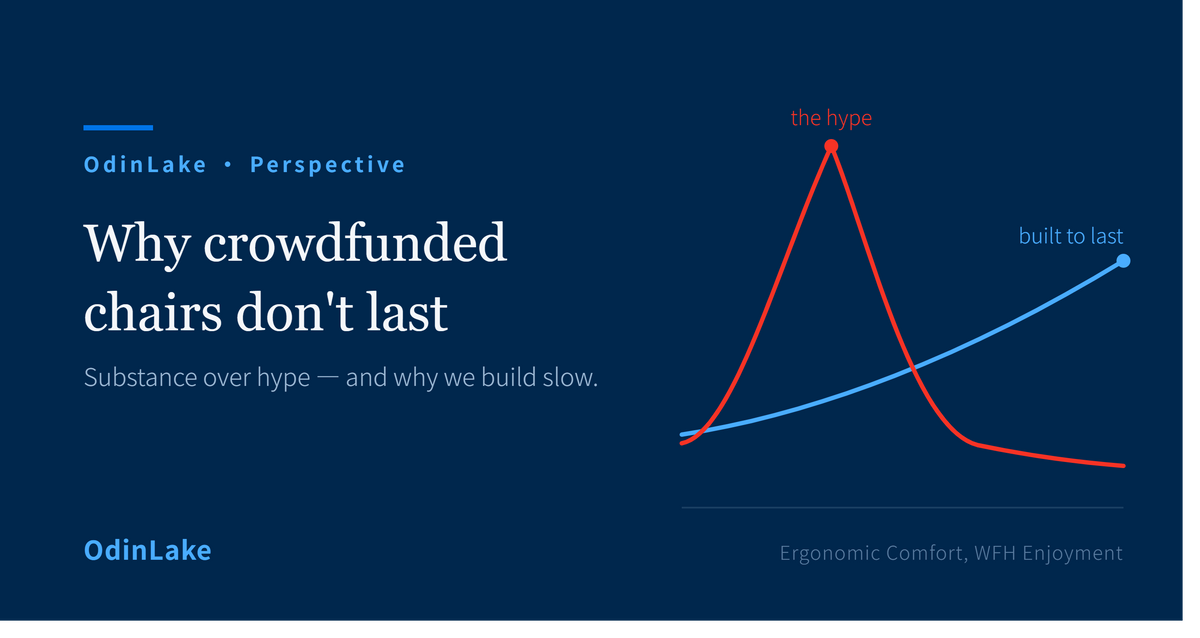
Bolder shapes. Stranger mechanisms. Slick two-minute videos promising to "reinvent how you sit." The pledges pour in fast — 300%, 800%, sometimes a few thousand percent of the goal, funded in a matter of days.
On paper, these campaigns are a runaway success.
But pull the timeline forward a year or two, and a different story shows up. A lot of those once-buzzy projects have gone quiet. Ship dates slip, then slip again. Support emails go unanswered. The comment sections fill with backers still waiting. That chair that was going to "reinvent sitting" never actually sat under anyone for long.
The hype is real. The problem is how short it lasts.
We're not knocking the creativity. Some of the designs on these platforms are genuinely beautiful, and they push the whole industry forward.
The issue is where the project starts.
When the goal on day one is raise as much money, as fast as possible, the marketing budget goes toward noise — not toward a chair you can actually sit in for eight hours a day, five days a week, for years. And noise is easy to buy. It's also the first thing to disappear once the campaign closes and the algorithm moves on to the next shiny thing.
It's not the design that fails. It's the starting point.
A financing-first mindset is a hard way to earn lasting trust.
People don't pay for the same marketing twice. They stick around for one reason: the chair actually feels good, day after day, long after they've forgotten the launch video. That's the part a splashy campaign can't fake — and it's exactly the part that gets shortchanged when the whole plan is built around the raise.
At OdinLake, we build it the other way around
We flipped the order.
We're not chasing the trend, and we're not trying to manufacture a frenzy. We'd rather keep our heads down and get every step right: answer the question a customer actually asked, act on the feedback we get, sweat the small details most people never notice.
In an industry obsessed with fast, slowing down to make a better chair — and take better care of the person sitting in it — sounds almost backwards. We're okay with that. A good chair doesn't prove its worth in one viral week. It proves it quietly, over years, in someone's home office or classroom or cubicle.
"User-first" isn't a slogan for us. It's the plain, unglamorous work we do every day: solving the customer's problem, then doing it again tomorrow.
Our real scorecard: repeat buyers and B2B clients
Whether the slow road is working isn't really ours to claim. Our customers answer that for us.
Over the last few years, more and more organizations have come to us on their own — school districts, universities, government agencies — buying, and then buying again. These are ruthlessly practical buyers. They don't order a thousand chairs because of a cool video. They look at reliability, at whether the support holds up, at whether a brand will still be standing behind them next year.
When an institution trusts us with hundreds or thousands of seats at a time, that's the most honest feedback we could ask for. It tells us the boring, steady approach was the right one all along.
The bottom line
Crowdfunding is exciting, and we respect the nerve it takes to put a wild idea out into the world.
But we know exactly what kind of brand we want to be. Not the name that lights up your feed for a week and then disappears. The one whose chair is still there — and still supported — after you've changed jobs twice and moved across the country.
The hype always fades. What we want to leave behind is the product, and the trust you put in us.