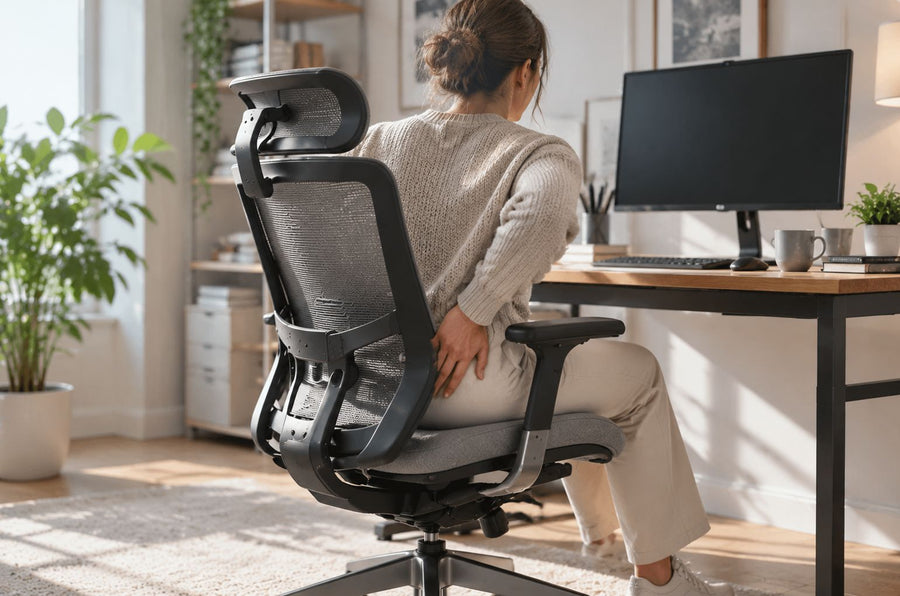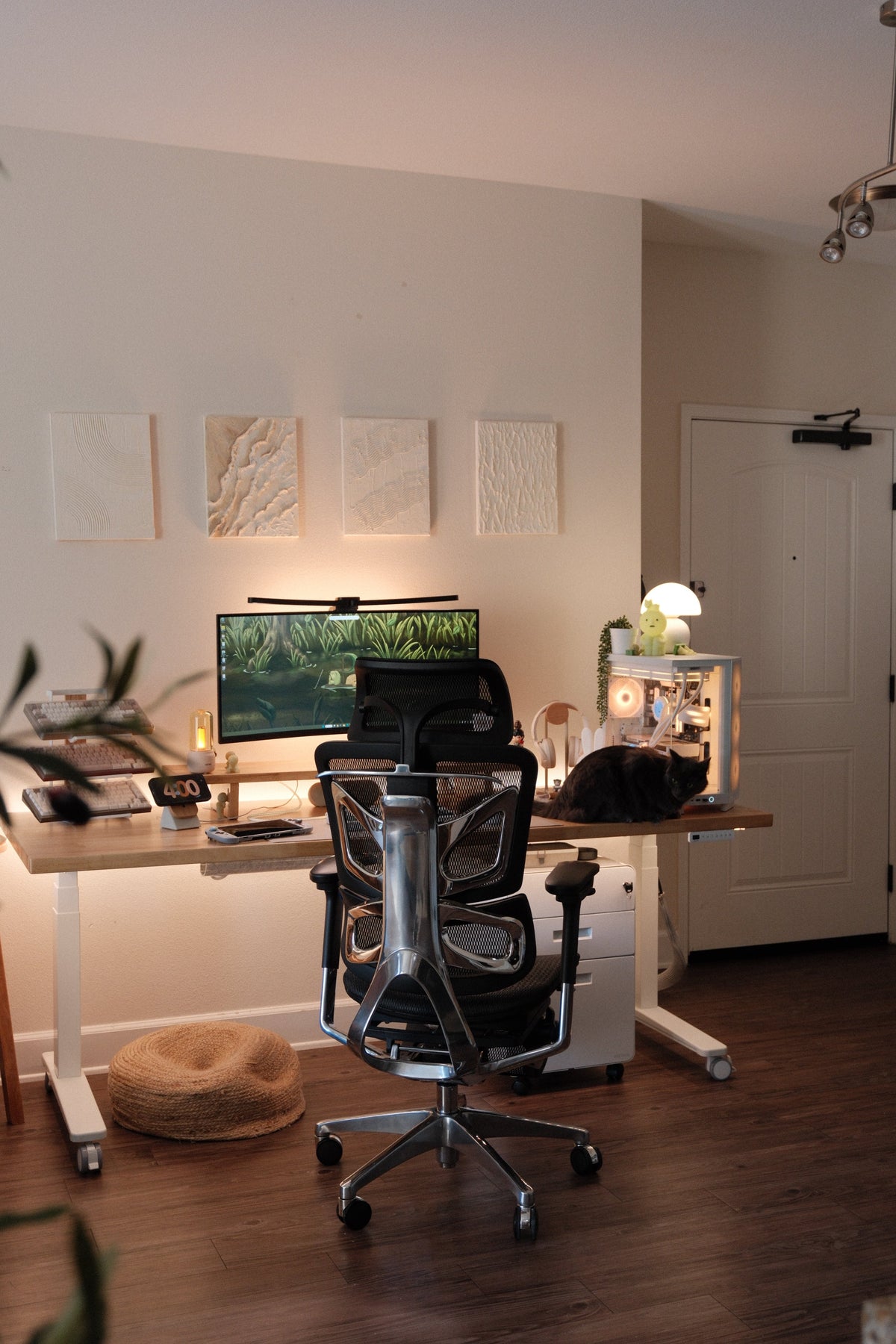
The right ergonomic setup should adapt to your body, support frequent movement, and stay comfortable through a full workday.
You do not automatically need an office chair mat. You need one when the care or warranty instructions for your exact floor require it, when your chair is already leaving marks or catching, or when a suitable mat is the most practical way to control rolling wear. A no-mat setup can be reasonable only when the flooring maker allows direct caster use, the chair’s casters are compatible and undamaged, and a short monitored test produces no visible or functional change.
That answer depends on a system, not one product: the flooring, finish, underlayment, caster material, chair load, debris, and the area you actually roll across. A “hardwood-safe” wheel or “all-floor” mat label does not overrule the floor manufacturer’s instructions. Use the floor-by-floor process below to make a decision you can document and recheck.
Start with the floor maker, not the mat listing
First identify the exact flooring product. Look for an invoice, leftover plank or tile, box label, landlord record, or installation document. Then search its current care and warranty materials for terms such as caster, rolling chair, chair mat, area rug, backing, and furniture protection.
This step matters because products that look alike can have different rules. For example, the product-specific Garrison Diana laminate care guide tells owners to use a hard-surface chair mat under rolling office chairs and to avoid rubber-backed mats. By contrast, Shaw’s general vinyl-care page discusses wide load-bearing rollers and warns against latex- or rubber-backed mats. Neither instruction should be generalized to every laminate or vinyl floor; each shows why the exact document comes first.
If you cannot identify the floor, do not guess from color or grain. Ask the installer, landlord, builder, or flooring maker for written guidance. Until then, treat the setup as unverified and choose only reversible actions that do not introduce an incompatible backing, adhesive, or caster.
Use this floor-by-floor starting point
The table is a decision starter, not a substitute for the product documentation. “Verify first” means the floor maker’s instructions decide whether direct rolling, a specific caster, a particular mat, or a combination is permitted.
| Floor type | Starting decision | What to verify |
|---|---|---|
| Solid or engineered hardwood | Verify first; add protection when the finish, caster, grit, or rolling pattern creates risk | Finish warranty, approved caster material, mat backing, moisture exposure, and existing scratches |
| Carpet or carpet tile | A carpet-rated mat is often preferred when wheels sink, catch, or repeatedly compress one path | Pile and pad depth, mat stud design, total chair load, tile seams, and whether the mat stays flat |
| Laminate | Verify the exact product; some care guides explicitly require a hard-floor mat | Caster rules, backing restrictions, grit control, seam condition, and moisture trapped under a mat |
| Vinyl, LVP, or other resilient flooring | Verify rolling-load, caster, and backing rules before choosing a mat or direct rolling | Wheel width and material, protective-mat requirements, staining risk, and residual indentation |
| Tile, stone, or sealed concrete | A mat may be optional if the floor and casters permit direct rolling | Grout joints, uneven edges, debris, brittle or damaged casters, sealer instructions, and transitions |
| Unknown floor or rental | Verify before committing to either setup | Written landlord or manufacturer guidance, pre-existing condition, and a removable protection method |
For a complete wood-floor inspection and protection sequence, use OdinLake’s guide to protecting hardwood floors from an office chair. If the chair is on carpet, the separate office-chair carpet protection guide covers pile, pad, mat rating, and rolling resistance in more detail.
Inspect the chair and map the occupied travel zone

Do not size the problem from the chair’s parked footprint. Sit in the chair and map the full area used to reach the desk, stand up, open drawers, turn toward a second work surface, and leave the workstation. That occupied travel zone is the surface the casters and any mat must manage.
- Clean and inspect all casters while the chair is unoccupied. Remove loose hair and grit using the chair maker’s instructions. Stop using the chair if a wheel is cracked, loose, jammed, or mounted to a damaged base.
- Mark the farthest seated positions. Use removable paper markers outside the rolling path, not tape or adhesive on an unverified floor.
- Check transitions and walking routes. A mat edge should not sit where feet regularly cross, where a door catches it, or where one caster repeatedly drops on and off the edge.
- Look for early evidence. Scratches, dull tracks, compressed carpet, open seams, discoloration, or a wheel that suddenly catches mean the current arrangement needs correction before a longer test.
If your travel zone is larger than the mat, do not assume the uncovered section is harmless. Reposition the workstation, choose a correctly rated larger mat, or restrict the rolling route without compromising safe entry and exit.
When a no-mat setup can be reasonable
Direct rolling is a defensible choice only when every relevant condition below is satisfied:
- The exact flooring care and warranty instructions allow the caster or rolling-chair use you intend.
- The chair manufacturer allows the installed casters, and the caster material and dimensions are suitable for that floor.
- All wheels roll and swivel freely, with no cracks, sharp edges, embedded grit, or missing parts.
- The floor is clean, dry, fully cured or acclimated as required, and has no damaged seams or finish in the travel zone.
- The complete occupied travel zone stays on one compatible surface without catching at thresholds or grout lines.
- A monitored test shows no scratching, dulling, indentation, discoloration, seam movement, or change in rolling effort.
Start with a brief seated roll test, not a full workday. If that passes, inspect again after the first day and first week. Use raking light from the side to reveal changes that overhead light can hide. Stop at the first unexplained mark or change in feel; continuing the test does not make the setup more compatible.
When a chair mat is the safer default
A suitable mat is the more conservative starting choice when the floor maker requires it or when the current system has an unresolved risk. That includes these situations:
- The care guide names a protective mat for rolling chairs.
- The floor product, finish, or caster type cannot be identified.
- Grit is repeatedly tracked into the rolling area.
- The wheels sink into carpet, catch at tile seams, or require excessive effort to move.
- The floor already shows fresh scratches, dull tracks, compressed fibers, or indentation.
- The workstation is in a rental or another setting where reversible risk control is especially important.
- A user’s reach pattern creates frequent high-load turns in the same small area.
“Safer default” does not mean any mat is safe. The wrong backing can discolor a resilient floor, carpet studs can damage a hard floor, and a mat that curls or slides can create a new problem. The mat still has to match the floor, load, and travel zone.
Choose the mat by application
For hard floors
Choose a mat specifically labeled for the exact hard-floor category allowed by the flooring maker. A flat underside is commonly used on hard surfaces; do not put a studded carpet mat on wood, laminate, vinyl, tile, or stone unless both manufacturers explicitly approve that application. Check the backing material as carefully as the top surface, especially where rubber, latex, plasticizer, or adhesive contact is restricted.
For carpet
Use a carpet-rated mat whose pile and pad specification covers your installed carpet. A label such as “low pile” is useful only if your carpet system falls within the maker’s stated limit. Confirm the mat’s load rating includes the seated user and chair, and make sure any anchoring studs are intended for that carpet rather than the hard surface below it.
For vinyl and laminate
These floors need product-specific checking because a clear mat can still have an incompatible backing or trap material that affects the surface. Mannington’s product-specific ADURA Flex care guidance, for example, calls for non-staining mats and specifies a minimum flat surface width for furniture casters. Treat that as an example for that product line, then find the corresponding rule for your own floor.
For the occupied rolling area
The mat must support all casters during normal seated work, entry, and exit. Measure the width and depth of the occupied travel zone, then compare those measurements with the mat’s usable flat area—not merely its shipping dimensions or decorative lip. A larger mat is not automatically better if it blocks a door, crosses a transition, or puts an edge in a walkway.
Install and test without creating a new hazard
- Follow both sets of instructions. Read the flooring care guide and the mat installation guide before unrolling or placing the mat.
- Clean both contact surfaces. Remove grit from the floor and the underside of the mat using approved methods, then let both surfaces dry fully.
- Let the mat settle as directed. Do not force a rolled mat flat with heat, heavy furniture, adhesive, or another improvised method unless its maker specifically instructs you to do so.
- Position the edge outside routine foot traffic. OSHA does not publish a chair-mat installation standard, but its interpretation about outside doormats illustrates the broader housekeeping concern: unsecured or raised mat edges can contribute to a trip hazard.
- Test while seated. Roll slowly to every marked work position. Stop if a caster catches, the mat slides, an edge lifts, or the surface flexes or cracks unexpectedly.
- Inspect underneath. Recheck after the first day and first week for trapped grit, moisture, discoloration, residue, indentation, or movement.
Do not use tape, adhesive, or anti-slip material merely to hide an unstable mat. First confirm that the added material is approved by both the mat and floor manufacturers and will not transfer color, soften a finish, or leave residue.
Can casters, rugs, or glides replace a mat?
Sometimes, but each alternative changes the system and needs its own compatibility check.
| Alternative | When it may help | What it does not solve automatically |
|---|---|---|
| Soft or rollerblade-style casters | When both chair and floor makers approve the size, stem, material, and load | Grit, finish restrictions, concentrated load, seam damage, or an incompatible chair base |
| Area rug | When the floor maker allows its fiber, dye, and backing and the chair can move safely | Rolling resistance, bunching, edge catching, or prohibited rubber or latex backing |
| Stationary glides | When rolling is unnecessary and the chair maker approves replacing casters | Dragging damage, safe chair movement, or compatibility with the base sockets |
| Frequent cleaning alone | As part of every setup to control grit and hair | A floor warranty that requires a mat, unsuitable casters, or concentrated rolling wear |
If replacement wheels are part of the decision, start with the OdinLake chair accessories collection and verify the exact chair model, stem, floor guidance, and load before buying. A wheel that fits physically is not necessarily approved for the chair or floor.
Recheck the system, not just the floor
Your decision can change as the setup changes. New debris, a worn caster, seasonal moisture, a shifted mat, or a rearranged desk can turn a previously acceptable route into a damaging or awkward one. During normal cleaning, inspect all caster treads, mat edges, the mat underside, and the floor beneath it. Recheck after moving the desk or chair, replacing wheels, changing the floor finish, or noticing a change in sound or rolling effort.
Keep a photo of the clean floor before the test and note the floor product, caster model, mat model, and date. That small record makes future changes easier to compare and gives a flooring or chair manufacturer useful context if you need support.
Make the decision with three records
Before buying a mat, collect the floor care guide, the chair or caster specification, and a simple map of your occupied travel zone. Those three records will usually tell you whether a mat is required, preferred for risk control, optional after verification, or not yet safe to choose. If the documents conflict, pause the setup and ask the floor and chair manufacturers for written guidance rather than relying on a generic product label.
Frequently asked questions
Do I need a chair mat on hardwood floors?
Not in every hardwood setup. Check the exact flooring and finish instructions, then assess caster compatibility, grit, and the full rolling path. If any of those are unverified or the floor is marking, use an approved protective method and follow the detailed hardwood-floor guide.
Do I need a chair mat on carpet?
A carpet-rated mat is often useful when the wheels sink, catch, or repeatedly compress the same area, but it must match the pile, pad, and total load. A thin low-pile mat may be unsuitable for a deeper carpet system. The carpet protection guide provides the full selection and testing process.
Can soft or rollerblade-style casters replace a chair mat?
Only when the chair maker permits the replacement and the floor maker approves that caster type for direct rolling. Soft tread does not eliminate embedded grit, concentrated load, damaged seams, or a floor-specific mat requirement.
What type of chair mat is safe for vinyl or laminate?
Use the type and backing explicitly allowed by the exact flooring product and choose a mat rated for hard floors, the combined seated load, and the full occupied travel zone. Avoid assuming that a clear or “universal” mat is non-staining or compatible.
How large should an office chair mat be?
It should keep every caster on the supported surface throughout normal seated work, reaching, entry, and exit. Measure that occupied travel zone first, then ensure the usable flat portion of the mat covers it without placing an edge in a doorway or walking route.
Can a chair mat damage the floor underneath?
Yes, an incompatible backing, trapped grit or moisture, staining material, excessive flex, or an unsuitable studded underside can harm some floors. Follow both manufacturers’ instructions and inspect underneath after installation instead of treating the mat as a set-and-forget barrier.